


Securing a mortgage for a commercial property is a landmark achievement for any business. It represents a significant step towards growth, stability, and building long-term wealth. The journey to securing the right loan, however, is fraught with financial complexities that extend far beyond the initial purchase price. The true cost of a business mortgage is a multifaceted equation involving not just the principal and interest, but also a variety of other factors including loan terms, amortization periods, closing costs, and ongoing expenses like taxes and insurance. Miscalculating these costs can have profound consequences, straining cash flow, hindering operational capacity, and ultimately jeopardizing the investment itself.
This is where a business mortgage calculator proves to be an essential analytical tool. It serves as a financial planning instrument, allowing entrepreneurs to project the future of their loan and understand its true financial impact. By inputting a few key variables, a business owner can instantly see a detailed breakdown of their financial obligations. This includes the monthly payment and a complete amortization schedule, which illustrates how each payment is allocated between principal and interest over the entire life of the loan. This level of foresight is invaluable. It enables strategic financial planning, helps in comparing different loan offers with precision, and provides the data-backed confidence needed to negotiate favorable terms with lenders.
This article is designed to be the definitive guide to using a business mortgage calculator. We will explore how to use this tool to accurately forecast all associated costs, from the initial down payment to the final balloon payment. We will examine the core components of a commercial mortgage, demystify complex concepts like amortization and debt service coverage ratio (DSCR), and shed light on the hidden costs that often catch borrowers by surprise. With the practical steps provided here, you will be equipped to make smarter, more strategic decisions, ensuring your commercial real estate investment is a foundation for success, not a source of financial strain.
How to Use a Business Mortgage Calculator: A Step-by-Step Guide
A business mortgage calculator is a powerful yet user-friendly tool designed to demystify the costs associated with a commercial property loan. By following a few simple steps, you can gain a clear and accurate picture of your potential financial commitment. This allows for precise budgeting, effective comparison of loan offers, and strategic long-term planning. The primary goal is to transform complex loan variables into a straightforward monthly payment and a total cost figure, providing the clarity needed to make confident financial decisions.
Here is a detailed breakdown of the inputs required and the outputs you can expect from a standard business mortgage calculator:
Step 1: Property Purchase Price
This is the total agreed-upon price for the commercial property you intend to buy. It serves as the starting point for all subsequent calculations. Whether you are purchasing a retail storefront, an office building, or a multifamily apartment complex, this figure anchors the entire analysis.
Step 2: Down Payment
Enter the total amount of cash you plan to pay upfront. This is typically expressed as a percentage of the purchase price. Down payment requirements vary significantly by loan type. SBA 504 and SBA 7(a) loans may require as little as 10%, while conventional commercial loans often demand 20% to 25% [1]. The calculator will subtract the down payment from the purchase price to determine the initial loan amount.
Step 3: Loan Amount
This is the principal amount you are borrowing from the lender. If you entered a purchase price and down payment, most calculators will compute this for you automatically. You can also enter it directly if you already know the exact amount you need to borrow.
Step 4: Interest Rate
Input the annual interest rate quoted by your lender. Commercial mortgage rates can be fixed or variable. For forecasting purposes with a variable rate loan, it is wise to run scenarios using both the current rate and a higher rate to stress-test your financial model. As of early February 2026, average rates for conventional commercial loans hover around 6.23%, while SBA-backed loans can be slightly lower, with SBA 504 loans starting at 5.68% [1].
Step 5: Loan Term (in Years)
This is the period over which you have agreed to repay the loan. Commercial loan terms are often shorter than residential mortgages, commonly ranging from 5, 10, or 15 years, even if the payment schedule is calculated over a longer period. Understanding the distinction between the loan term and the amortization period is one of the most critical aspects of commercial lending.
Step 6: Amortization Period (in Years)
This is a crucial and often misunderstood input. The amortization period is the length of time over which the loan payments are calculated. It is frequently longer than the loan term itself. A loan might have a 10-year term but be amortized over 25 years. This results in lower monthly payments during the term, but leaves a large remaining balance (a “balloon payment”) due at the end of the 10-year term. Entering the correct amortization period is essential for an accurate monthly payment estimate.
Step 7: Additional Annual Costs
A well-designed calculator will allow you to include other property-related expenses. These include annual property taxes, property insurance, and any homeowners association (HOA) or commercial property owners association (CPOA) fees. Including these provides a more realistic estimate of your total monthly outlay, giving you a clearer picture of the actual cash flow impact on your business.
Once you input these variables and click “Calculate,” the tool will provide a wealth of information, including your estimated monthly payment (Principal and Interest), total payments over the loan term, total interest paid, and a complete amortization schedule. Each of these outputs is a building block for making a well-informed financing decision.

Decoding the Results: Understanding Amortization
After you input your loan details into a business mortgage calculator, it generates an amortization schedule, which is arguably the most insightful piece of information it provides. An amortization schedule is a detailed, table-based breakdown of your loan payments over time. It meticulously separates each monthly payment into two components: the portion that goes toward paying down the principal (the amount you borrowed) and the portion that covers the interest (the cost of borrowing).
At the beginning of a loan, a much larger portion of your payment is allocated to interest. As time goes on, this allocation slowly shifts. With each payment, you build a small amount of equity, and the outstanding loan balance decreases. The interest calculated on that smaller balance also decreases. This allows a progressively larger portion of your fixed monthly payment to be applied to the principal. This gradual shift is the essence of amortization [5].
Understanding this process is critical for several reasons. It reveals the true cost of borrowing over the long term and helps you visualize how and when you are building equity in your property. For many business owners, seeing the sheer amount of interest paid in the early years can be a powerful motivator to consider strategies like making extra principal payments to accelerate equity growth and reduce the total interest paid.
Let us consider a typical $1,000,000 commercial mortgage with a 25-year amortization period at a 6.23% fixed interest rate. The chart below visualizes the amortization schedule on an annual basis.
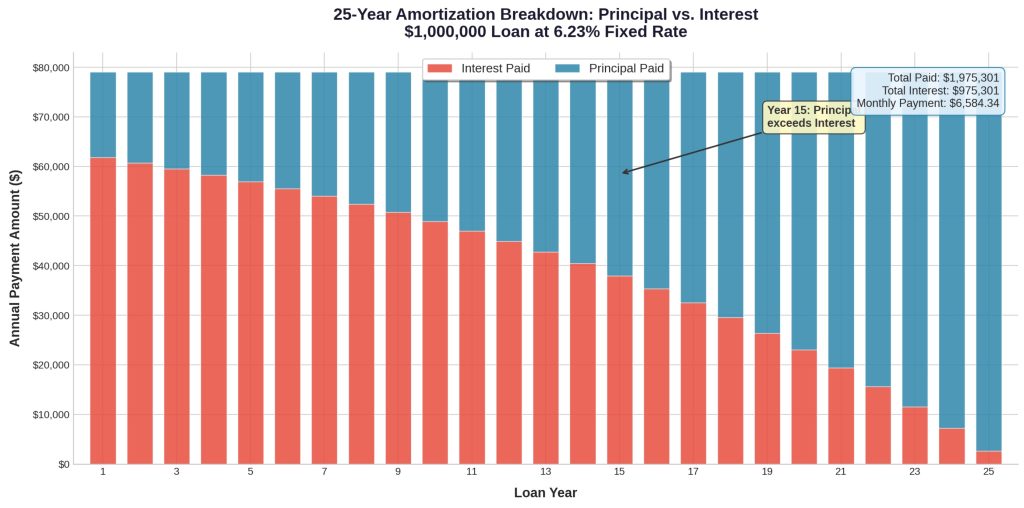
As the chart illustrates, in the early years of the loan, the interest portion (in red) dominates the annual payments. For the first 14 years, more of your money is going to the lender as profit than to paying down your actual loan balance. It is not until Year 15 that the principal portion (in blue) exceeds the interest portion. Over the full 25-year term, the total interest paid on this $1,000,000 loan amounts to a staggering $975,301 — nearly doubling the cost of the property [1]. This visualization underscores the immense long-term impact of interest rates and the importance of understanding your amortization schedule from day one.
The implications of this are significant for your business planning. If you are acquiring a property with the intent to sell or refinance within 5 to 7 years, you should recognize that the majority of your payments during that period will be going toward interest, not equity. This reality must be factored into your investment return calculations. If you plan to hold the property for the full 25-year term, you can take comfort in knowing that the equity-building accelerates dramatically in the later years.
Amortization Period vs. Loan Term: A Critical Distinction
One of the most common sources of confusion in commercial lending is the difference between the amortization period and the loan term. These are two separate concepts, and conflating them can lead to serious financial miscalculations. Understanding this distinction is paramount to using a business mortgage calculator accurately and to avoiding a potentially devastating surprise at the end of your loan term.
The amortization period is the total time frame used to calculate the size of your monthly payments. A longer amortization period (e.g., 25 or 30 years) results in smaller monthly payments because the principal is spread over a greater number of payments. The loan term, by contrast, is the actual duration of your loan agreement with the lender. When the loan term expires, the remaining balance of the loan becomes due in full.
In residential lending, the amortization period and the loan term are typically the same. A 30-year mortgage has a 30-year term and a 30-year amortization. In commercial lending, this is rarely the case. It is extremely common for a commercial mortgage to have a 25-year amortization period but only a 5-year or 10-year loan term. This means your monthly payments are calculated as if you were paying off the loan over 25 years, but after 10 years, you must pay the entire remaining balance — the balloon payment — in one lump sum.
This balloon payment can be substantial. On a $1,000,000 loan at 6.23% with a 25-year amortization and a 10-year term, the remaining balance after 10 years of payments would still be approximately $758,000. This means that after a decade of making monthly payments totaling over $790,000, you would still owe the lender more than three-quarters of the original loan amount. At that point, you would need to either refinance the loan, sell the property, or pay the balloon in cash.
When using a business mortgage calculator, always ensure you are entering both the amortization period and the loan term correctly. If the calculator only has one field for “term,” it may be calculating your payments based on the amortization period, which could mask the reality of a balloon payment. Always ask your lender to specify both figures and model the balloon payment scenario in your financial projections.
The Power of Comparison: Modeling Different Loan Scenarios
One of the most powerful features of a business mortgage calculator is its ability to model and compare different scenarios instantly. The financing offer you receive from one lender is not the only option available, and even small variations in interest rates or loan structures can have a massive impact on your total cost of borrowing over the long term. By adjusting the inputs in the calculator, you can directly compare the financial implications of different rates, terms, and down payments.
This capability is invaluable during the negotiation process. When you can quantify the long-term savings of a slightly lower interest rate, you are in a much stronger position to negotiate with lenders. Demonstrating that you understand the financial impact of a 0.25% rate reduction shows that you are a sophisticated borrower and can encourage lenders to offer more competitive terms.
Let us explore the impact of interest rates on a $1,000,000 business mortgage with a 25-year amortization period. The chart below compares the total cost of borrowing across a range of interest rates, from 5.00% to 8.00%.
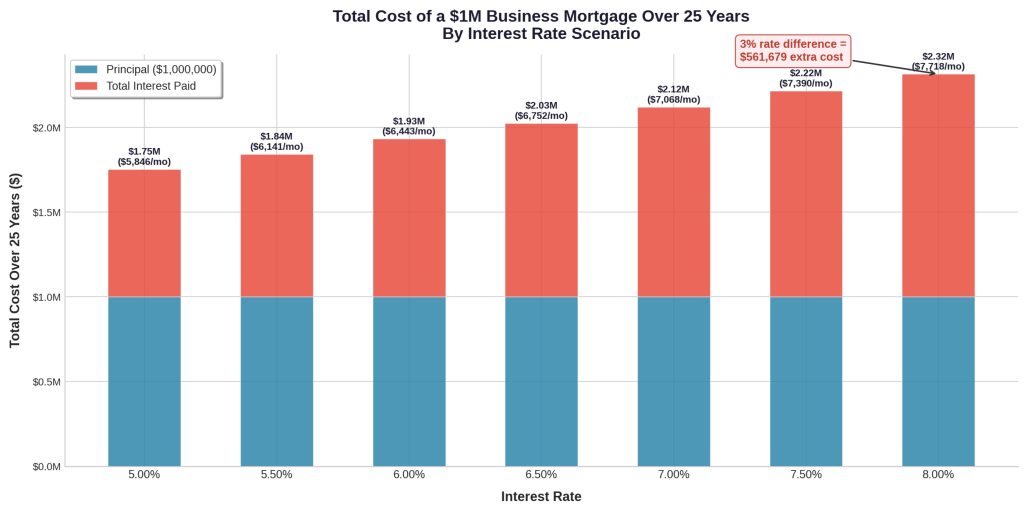
The results are striking. At a 5.00% interest rate, the total cost over 25 years is approximately $1.75 million, with $750,000 paid in interest. At an 8.00% rate, the total cost balloons to over $2.32 million, with more than $1.32 million paid in interest. This represents a difference of over $561,000 in total cost for the same loan amount, stemming from just a three-percentage-point difference in the interest rate [1]. This visualization powerfully illustrates why shopping for the best possible rate is not just a minor optimization but a critical strategic imperative that can save your business hundreds of thousands of dollars over the life of the loan.
Beyond interest rates, you can also model different loan types. The commercial mortgage market is diverse, with options ranging from conventional bank loans to government-backed programs like SBA 504 and SBA 7(a) loans, as well as CMBS and short-term bridge loans. Each comes with its own typical rates, terms, and down payment requirements [2].
The chart below compares the monthly payment and total cost for a $1,000,000 property purchase across these different loan types, using average rates and terms for February 2026.
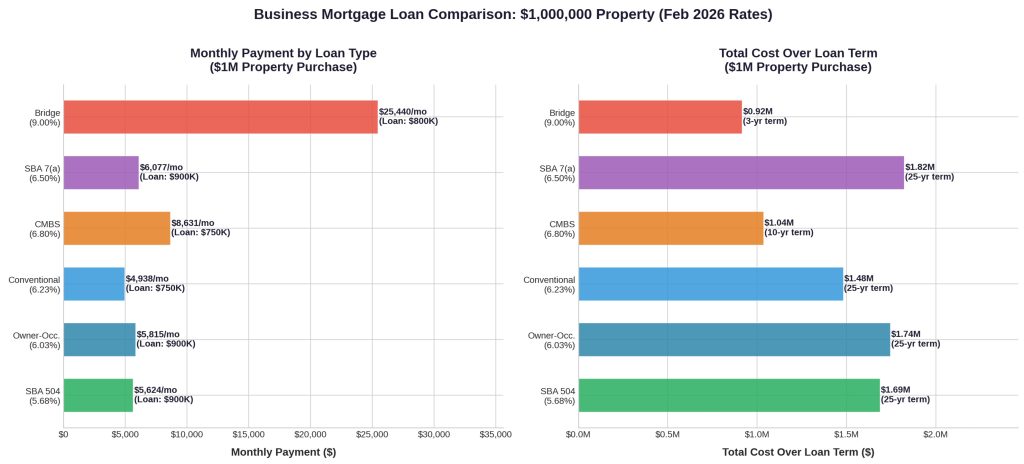
This comparison reveals a crucial trade-off. A conventional loan with a 25% down payment has one of the lowest monthly payments ($4,938), but a higher total cost over 25 years ($1.48M) compared to some other options. An SBA 504 loan, with only a 10% down payment, has a higher monthly payment ($5,624) but a lower interest rate, resulting in a competitive total cost. A short-term bridge loan, with its high 9.00% interest rate, has by far the highest monthly payment ($25,440) but is designed for short-term financing, not long-term ownership. By using a calculator to run these comparisons, you can identify the loan structure that best aligns with your business’s cash flow, long-term strategy, and risk tolerance.
Choosing the Right Loan Type: A Detailed Comparison
Selecting the right type of business mortgage is just as important as securing a favorable interest rate. Each loan product is designed for a specific type of borrower, property, and financial situation. Using your business mortgage calculator to model each option side by side is the best way to determine which product offers the most value for your particular circumstances. Below is a detailed comparison of the most common commercial loan types available in 2026.
| Loan Type | Typical Rate (Feb 2026) | Max LTV | Typical Term | Amortization | Best For |
| :— | :— | :— | :— | :— | :— |
| SBA 504 | 5.68% | Up to 90% | 10–25 years | 25 years | Owner-occupied properties, long-term fixed-rate financing |
| SBA 7(a) | 6.50% | Up to 90% | 10–25 years | 25 years | Flexible use, working capital, smaller commercial purchases |
| Conventional Bank | 6.23% | Up to 75% | 5–15 years | 25 years | Established businesses with strong financials, investment properties |
| CMBS | 6.29%–7.30% | Up to 75% | 5–10 years | 25–30 years | Larger commercial properties, non-recourse financing |
| Bridge Loan | 9.00%+ | Up to 80% | 1–3 years | Interest-only or short amortization | Short-term acquisitions, renovations, transitional properties |
| Owner-Occupied | 6.03% | Up to 90% | 5–25 years | 25 years | Businesses purchasing their own operating space |
Source: Select Commercial, February 2026 [1]
The SBA 504 loan stands out as a particularly attractive option for businesses that plan to occupy the property themselves. It offers the lowest fixed rates, the highest loan-to-value ratio (meaning a smaller down payment), and long-term stability. The trade-off is a more rigorous application process and specific eligibility requirements, including job creation mandates. Conventional bank loans offer more flexibility but typically require a larger down payment and may come with shorter terms that result in balloon payments [2].
When you input each of these options into your business mortgage calculator, pay close attention to the total cost of borrowing over the full term, not just the monthly payment. A loan with a lower monthly payment but a longer term or higher rate may end up costing significantly more in total interest over its lifetime.
Beyond the Calculator: Uncovering Hidden Costs
While a business mortgage calculator is an excellent tool for forecasting your monthly payments and total interest, it is crucial to recognize that it does not capture the full financial picture. The total cost of acquiring a commercial property involves a significant number of additional expenses, often referred to as closing costs or soft costs. These fees are charged by the lender, attorneys, and other third parties to process, underwrite, and finalize the loan. These costs can be substantial, typically ranging from 2% to 5% of the total loan amount, and must be factored into your budget [3].
Failing to account for these hidden costs can lead to a serious budget shortfall at closing. It is essential to request a detailed breakdown of all anticipated fees from your lender early in the process. Here are some of the most common hidden costs you are likely to encounter:
| Fee Type | Description | Typical Cost |
| :— | :— | :— |
| Origination Fee | A fee charged by the lender for processing the loan application. | 0.5% to 2% of the loan amount |
| Underwriting Fee | Covers the cost of the lender’s due diligence in verifying your financial information and assessing risk. | $500 to $2,500 |
| Appraisal Fee | The cost of hiring a certified appraiser to determine the fair market value of the property. | $2,000 to $5,000+ |
| Environmental Report | A Phase I Environmental Site Assessment (ESA) is often required to check for contamination issues. | $1,500 to $6,000 |
| Title Insurance | Protects both the lender and the buyer from potential disputes over property ownership. | Varies by state and property value |
| Legal Fees | Fees for attorneys to review contracts, prepare closing documents, and facilitate the transaction. | $1,500 to $10,000+ |
| Survey Fee | The cost of a professional survey to verify property boundaries and identify any encroachments. | $1,000 to $2,500 |
| Inspection Fees | Covers the cost of a professional property condition assessment to identify any structural or system issues. | $1,000 to $5,000+ |
| SBA Guarantee Fee | For SBA-backed loans, the Small Business Administration charges a fee to guarantee the loan. | Varies by loan amount (up to 3.75%) |
Source: Biz2Credit [3], Avalara [8]
These are just some of the potential costs. Others may include recording fees, mortgage taxes, and broker commissions. Always ask your lender for a Loan Estimate or a Term Sheet that itemizes all anticipated closing costs. By understanding these expenses upfront, you can budget effectively and avoid any unwelcome financial surprises on closing day.
To get a more accurate total cost projection, add these estimated closing costs to the total interest figure generated by your business mortgage calculator. On a $1,000,000 loan, closing costs of 3% would add an additional $30,000 to your upfront expenses. This is a significant sum that must be accounted for in your financial planning.

The Lender’s View: Debt Service Coverage Ratio (DSCR)
While a business mortgage calculator helps you understand the loan from your own financial standpoint, it is equally important to understand how the lender evaluates the deal. The single most important metric for a commercial lender is the Debt Service Coverage Ratio (DSCR). The DSCR is a straightforward calculation that measures the property’s ability to generate enough income to cover its mortgage payments [4].
It is calculated as follows:
DSCR = Net Operating Income (NOI) / Total Annual Debt Service
Net Operating Income (NOI) is the property’s annual income (from rent and other sources) minus all operating expenses, before accounting for mortgage payments or income taxes. Total Annual Debt Service is the total of all principal and interest payments for the year.
Most lenders require a DSCR of at least 1.25x [4] [6]. This means that for every $1.00 of mortgage debt, the property must generate at least $1.25 in net operating income. This 25% cushion provides the lender with a margin of safety, ensuring that even if income drops or expenses rise unexpectedly, the property will still generate enough cash flow to make its mortgage payments. A DSCR below 1.0x indicates that the property is not generating enough income to cover its debt, resulting in negative cash flow — a situation lenders will not approve.
Let us walk through a practical calculation. Suppose you are considering a commercial property that generates $150,000 per year in gross rental income. After subtracting operating expenses of $50,000 (property management, maintenance, insurance, taxes), the NOI is $100,000. If the annual debt service on the proposed loan is $79,000 (approximately $6,584 per month on a $1M loan at 6.23%), the DSCR would be:
DSCR = $100,000 / $79,000 = 1.27x
This DSCR of 1.27x just barely meets the typical 1.25x minimum requirement. If operating expenses were to increase or if a tenant vacated, the DSCR could drop below the threshold. In this situation, you might consider a larger down payment to reduce the loan amount and annual debt service, which would improve the DSCR and strengthen your loan application.
Understanding DSCR is crucial for borrowers. Before you even apply for a loan, you should calculate the property’s DSCR to ensure it meets the lender’s minimum threshold. If the DSCR is too low, you may need to reconsider the deal, find ways to increase the property’s income or decrease its expenses, or come to the table with a larger down payment to reduce the loan amount.
The Benefits of Using a Business Mortgage Calculator
The consistent use of a business mortgage calculator throughout the property acquisition process offers a multitude of strategic advantages that go far beyond simple payment estimation. Integrating this tool into your workflow empowers you to make more informed, data-driven decisions at every stage.
1. Enhanced Financial Planning and Budgeting
The primary benefit is the ability to forecast your exact monthly payment and total financial commitment with a high degree of accuracy. This allows you to build a precise and reliable budget, ensuring that the new mortgage payment fits comfortably within your company’s cash flow. You can project your expenses months and years into the future, giving you the financial visibility needed to plan for growth, hiring, and capital expenditures alongside your mortgage obligations.
2. Improved Negotiation Power
When you can instantly model the long-term financial impact of a quarter-point interest rate reduction or a change in the amortization period, you enter negotiations with lenders from a position of strength. You are no longer just asking for better terms; you are demonstrating precisely why those terms matter and how they impact your business’s financial health. Lenders respect borrowers who come prepared with data, and this preparation often translates into more favorable loan offers.
3. Strategic Scenario Analysis
A calculator allows you to explore multiple possibilities. You can model the effect of increasing your down payment by 5%, opting for a 10-year term instead of a 15-year term, or preparing for a potential rate increase before you lock in your rate. By running these scenarios, you can stress-test your investment and develop contingency plans, reducing risk and increasing the likelihood of a successful outcome.
4. Clear Comparison of Loan Offers
Lenders often present offers in different formats, making direct, apples-to-apples comparisons difficult. By plugging the core variables of each offer into a standardized calculator, you can cut through the noise and objectively determine which loan truly offers the best value over the long run. This is especially valuable when comparing loans with different structures, terms, and fee schedules.
5. Long-Term Wealth Building Awareness
The amortization schedule provides a clear roadmap of your equity-building journey. It helps you understand how much of your investment is growing in value versus being spent on interest costs. This can inform strategic decisions about when to refinance, when to sell, or whether to make additional principal payments to accelerate your path to full ownership.
6. Risk Mitigation
By modeling worst-case scenarios — higher interest rates, longer vacancy periods, unexpected maintenance costs — you can identify potential vulnerabilities in your investment before they become real problems. This proactive risk assessment is one of the most valuable uses of a business mortgage calculator and can protect your business from financial distress.
In essence, a business mortgage calculator transforms a complex and often intimidating financial transaction into a manageable and transparent process. It is a tool for clarity, confidence, and strategic control.
Common Mistakes to Avoid When Using a Mortgage Calculator
A business mortgage calculator is only as accurate as the data you feed into it. Many borrowers make avoidable errors that lead to inaccurate projections and, ultimately, poor financial decisions. Being aware of these common pitfalls will help you use the tool more effectively and produce more reliable forecasts.
Mistake 1: Confusing the Loan Term with the Amortization Period
As discussed earlier, these are two different concepts in commercial lending. If you enter a 25-year amortization period as your “loan term” in a calculator that does not differentiate between the two, you may not account for a balloon payment that could be due in 5 or 10 years. Always verify that you are entering both figures correctly.
Mistake 2: Ignoring Variable Rate Risk
If your loan has a variable interest rate, running the calculator with only the initial rate gives you an incomplete picture. Variable rates are tied to a benchmark index (like the Prime Rate or SOFR) and can fluctuate significantly over the life of the loan. Run your calculations using the current rate, a rate 1% higher, and a rate 2% higher to understand the range of potential monthly payments.
Mistake 3: Forgetting Closing Costs and Fees
The calculator’s output focuses on principal and interest. It does not account for the origination fees, appraisal costs, legal fees, and other closing costs that can add 2% to 5% to your upfront expenses [3] [8]. Always add these estimated costs to your total budget.
Mistake 4: Overlooking Property Operating Expenses
Your mortgage payment is just one component of your total monthly cost of owning a commercial property. Property taxes, insurance, maintenance, property management fees, and potential vacancy costs must all be factored into your financial model. A calculator that only shows principal and interest can give a misleadingly optimistic picture of your actual cash flow.
Mistake 5: Failing to Account for Prepayment Penalties
Many commercial loans include prepayment penalties that can be substantial, especially in the early years of the loan. If you plan to sell or refinance the property before the loan term expires, you need to understand these penalties and factor them into your exit strategy. A standard calculator will not show you this cost, so you must obtain this information directly from your lender.
By avoiding these common mistakes, you can ensure that the projections generated by your business mortgage calculator are as accurate and useful as possible, giving you a solid foundation for your investment decisions.
Conclusion: From Calculation to Confident Decision-Making
In the high-stakes world of commercial real estate, financial clarity is not a luxury; it is a necessity. The journey to securing a business mortgage is complex, but it does not have to be opaque. The ultimate business mortgage calculator serves as a powerful analytical lens, bringing the true costs and long-term implications of your financing options into sharp focus. By moving beyond simple interest rate comparisons and embracing a thorough analysis that includes amortization, hidden fees, and lender-side metrics like DSCR, you transform yourself from a passive loan applicant into a savvy, strategic investor.
This guide has demonstrated that a calculator is more than just a number-crunching tool. It is a platform for scenario modeling, a catalyst for effective negotiation, and a roadmap for long-term financial planning. It empowers you to ask the right questions, compare offers with confidence, and structure a loan that aligns perfectly with your business’s financial realities and strategic ambitions. As you move forward in your property acquisition journey, make the business mortgage calculator your constant companion. Use it to test your assumptions, validate your strategy, and build a financial foundation that will support your business’s growth for years to come.
References
[1] SelectCommercial. (2026, February 9). Commercial Mortgage Rates Start at 5.18%. Retrieved from https://selectcommercial.com/commercial-mortgage-rates.php
[2] Peoples Bank. (2026, January 13). The Complete Guide to SBA Loans for Small Business Owners 2026 Edition. Retrieved from https://www.peoplesbankmtg.com/the-complete-guide-to-sba-loans-for-small-business-owners-2026-edition/
[3] Biz2Credit. (2025, September 12). The Costs No One Mentions in a Commercial Estate Loan. Retrieved from https://www.biz2credit.com/commercial-real-estate-loans/hidden-costs-commercial-estate-loans
[4] FNRP. (2026, January 14). What is Debt Service Coverage Ratio (DSCR) in Real Estate?. Retrieved from https://fnrpusa.com/blog/what-is-debt-service-coverage-ratio/
[5] Investopedia. (2024). Amortization Schedule: Definition, Formula, and Calculation. Retrieved from https://www.investopedia.com/terms/a/amortization.asp
[6] NerdWallet. (2026, February 3). Debt Service Coverage Ratio: What It Is & How to Calculate. Retrieved from https://www.nerdwallet.com/business/loans/learn/debt-service-coverage-ratio
[7] Freedom Capital. (n.d.). How To Use Commercial Mortgage Calculator For Maximum Benefit. Retrieved from https://www.freedomcapital.com/how-to-use-commercial-mortgage-calculator-for-maximum-benefit/[8] Avalara. (2018, June 7). The 12 hidden fees that could be associated with your small business loan. Retrieved from https://www.avalara.com/blog/en/north-america/2018/06/the-12-hidden-fees-that-could-be-associated-with-your-small-business-loan.html

Dean Tellone is the President & CEO of Tellone Financial Services, an Anaheim-based financial planning and private lending firm he founded in 1975. An Enrolled Agent with 40+ years in mortgages, estate and retirement planning, accounting, and taxes, he oversees $200M+ in mortgage funds and continues to serve homeowners across Southern California.

