
The best tax planning software for small businesses in 2026 is H&R Block Business for DIY filing and Corvee Tax Planning for strategic advisory services. The tax software market has split into two distinct categories: compliance-focused filing tools that help you prepare and submit returns, and proactive planning platforms that use AI and scenario modeling to reduce your tax burden year-round. Whether you are a freelancer seeking a free filing solution or a growing firm ready to invest in professional-grade tax strategy, the right software can save you thousands of dollars annually and transform how you manage your business finances.
The Changing World of Small Business Tax Software
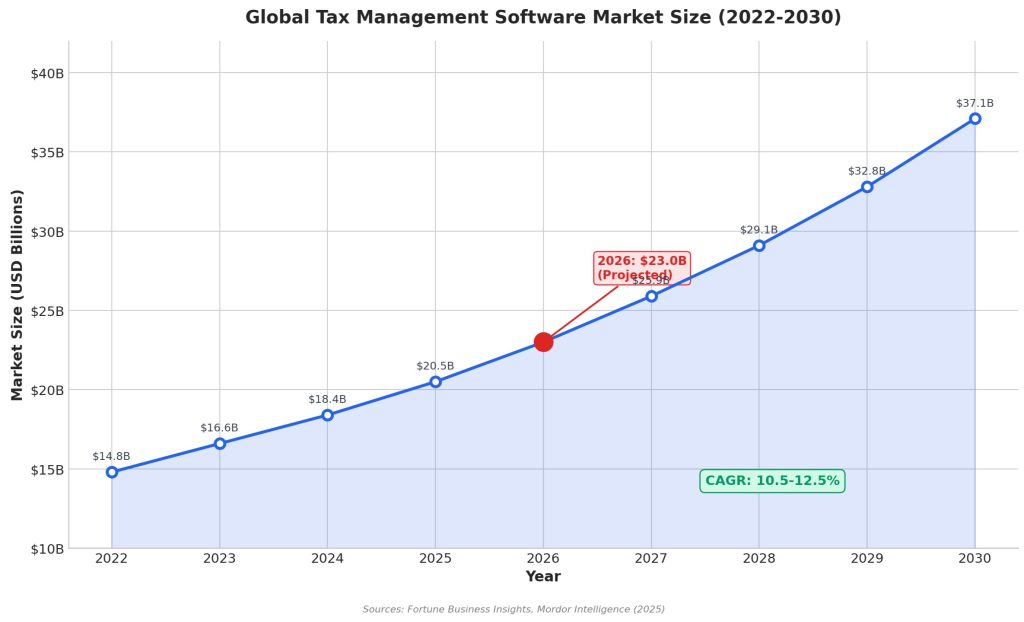
The world of small business finance is in a constant state of flux, and nowhere is this more apparent than in the tax software industry. Gone are the days of manually filling out stacks of paper forms or relying on simplistic desktop programs. The modern tax software market is a technology-driven ecosystem projected to grow from a market size of \$20.26 billion in 2025 to nearly \$37.1 billion by 2030, expanding at a compound annual growth rate (CAGR) of over 11% [6] [7]. This rapid growth is fueled by increasing regulatory complexity, the rise of the gig economy, and a powerful push towards automation and artificial intelligence.
For you, the small business owner, this presents both a challenge and an opportunity. The sheer number of options can be overwhelming, with solutions ranging from free mobile apps for freelancers to sophisticated, multi-thousand-dollar platforms for professional tax advisors. This diversity also means there is likely a perfect-fit solution for your specific needs, regardless of your business size, structure, or budget. The key is to understand the fundamental shift in the market: the divergence between tools designed for tax compliance (filing) and those built for strategic tax planning (advisory).
Tax compliance software, the more traditional category, focuses on accurately preparing and filing your annual tax returns. These tools, like H&R Block and TurboTax, are designed to guide you through the process, ensuring you meet your legal obligations. The newer and more disruptive category of tax planning software is designed to help you proactively minimize your tax liability throughout the year. These platforms, such as Corvee and TaxPlanIQ, are less about filling out forms and more about modeling scenarios, identifying strategic opportunities, and making data-driven decisions to improve your financial future.
The Rise of AI and Automation in Tax Tech
A major driver of this market shift is the integration of artificial intelligence and automation. For the 2025 tax year, leading platforms like TurboTax introduced new AI-powered features designed to streamline the tax preparation process. These tools can automatically import and categorize financial data, identify missing information, and offer personalized suggestions for deductions and credits [2]. This saves time and reduces the risk of human error, a significant concern for busy entrepreneurs who manage their own books.
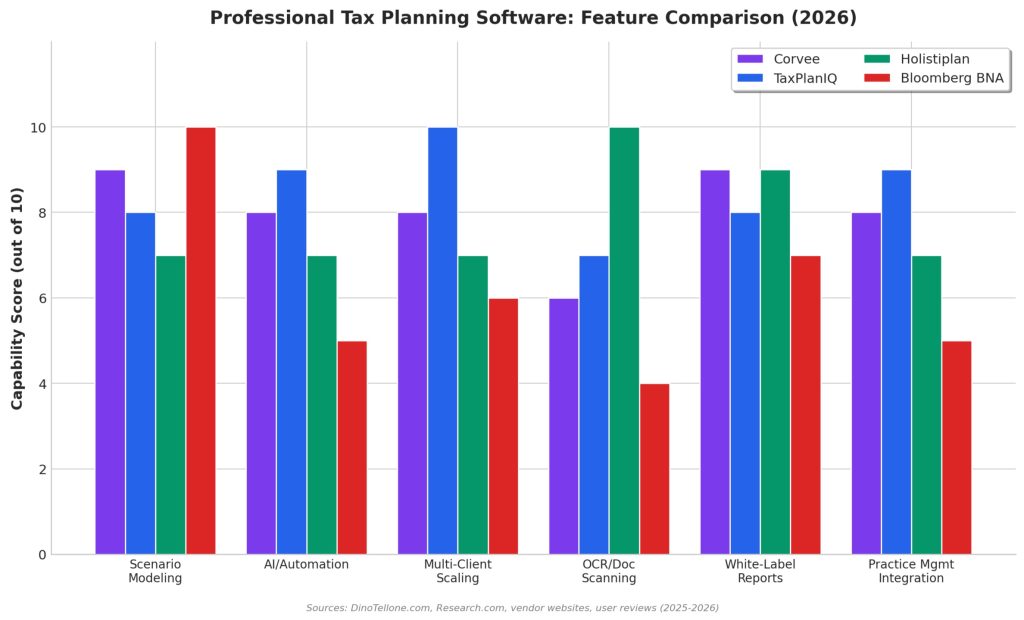
In the realm of professional tax planning, AI is playing an even more powerful role. Platforms like TaxPlanIQ leverage AI assistants (like their proprietary “jAIne”) to guide advisors through complex planning scenarios, while Holistiplan uses machine learning-enhanced Optical Character Recognition (OCR) to instantly scan and analyze entire tax returns, flagging opportunities in seconds [8] [9]. This level of automation allows a single advisor to provide high-level strategic advice to hundreds of clients, democratizing access to tax strategies that were previously reserved for the ultra-wealthy.
As you navigate this guide, it is crucial to keep this distinction in mind. Are you simply looking for a tool to help you file your taxes once a year, or are you seeking a partner to help you make smarter financial decisions year-round? The answer to that question will be the single most important factor in determining which software is right for you.
Market Growth and What It Means for You
The strong growth of the tax software market is a direct reflection of the increasing complexity of the tax code and the growing number of small businesses in the economy. The North American automated tax software market alone was valued at over \$7.4 billion in 2024, and it continues to expand rapidly [5]. This intense competition is a net positive for you as a consumer. It drives innovation, pushes prices down, and forces developers to create more user-friendly and powerful tools.
The tax planning software segment, in particular, is growing at 8% to 13% annually, reflecting a broader industry trend where businesses are moving from reactive compliance to proactive strategy [7]. Firms that adopt these tools report higher client retention and the ability to charge premium fees for advisory services, creating a virtuous cycle that benefits both the advisor and the business owner.
This guide will break down the best options available in 2026, providing clear, actionable advice to help you cut through the marketing noise and find the software that will best serve your business, not just on tax day, but every day of the year.
Category 1: Tax Filing Software for DIY Small Business Owners
For many small business owners, especially sole proprietors, freelancers, and those with straightforward finances, the primary goal is to file an accurate tax return with minimal fuss and expense. This is the domain of Do-It-Yourself (DIY) tax filing software. These platforms are designed to replace the traditional paper-and-pen process with a guided, interview-style experience, helping you identify relevant forms, claim eligible deductions, and submit your return electronically. The leaders in this space compete on price, user experience, and the breadth of business entities they support.
H&R Block Business: Best Overall
For years, H&R Block has been a household name in tax preparation, and its business software continues to lead the pack in 2026. Investopedia rates it as the best overall solution for small businesses, citing its thorough support for various entity types—including Partnerships (Form 1065), S Corporations (Form 1120-S), and C Corporations (Form 1120)—at a highly competitive price point [1].
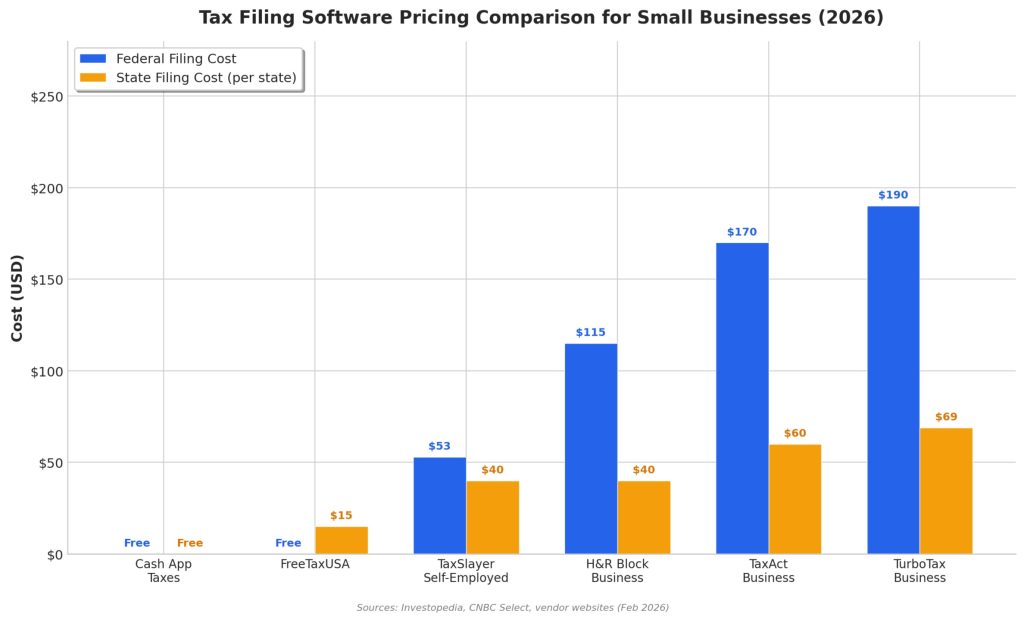
For a one-time cost of around \$115, the desktop software includes five federal e-filings, making it an exceptional value for entrepreneurs with multiple businesses or for accountants managing a small number of clients. While state filing comes at an additional cost (typically around \$40 per state), the initial package offers strong features, including asset depreciation calculators, W-2 and 1099 creation, and detailed guidance on complex topics. The primary drawback is its desktop-only format for business returns, which lacks the convenience of a fully online or mobile solution and is not available for Mac users [1].
TurboTax Business: Best for QuickBooks Integration
As part of the Intuit ecosystem, TurboTax Business offers an unparalleled advantage for the millions of small businesses that already rely on QuickBooks for their bookkeeping. The seamless integration allows for the direct import of income and expense data, dramatically reducing manual entry and the potential for errors. This feature alone makes it the top choice for dedicated QuickBooks users [2].
TurboTax offers both a desktop version (around \$190) and a full-service online package where a tax expert handles everything for you (starting at \$639). While the DIY desktop software is powerful, the full-service option provides peace of mind, offering year-round access to tax professionals for questions and audit support. The main criticisms of TurboTax are its higher price point compared to competitors and a sometimes-confusing shopping experience that can lead to unexpected upsells [1]. For those who value the convenience of the Intuit ecosystem and are willing to pay a premium for expert assistance, it remains a top contender.
TaxAct Business: Best Online Business Filing
TaxAct carves out a niche by offering a clear, straightforward online filing experience for a variety of business entities, a feature that sets it apart from H&R Block’s desktop-only approach. It supports partnerships, C Corps, and S Corps through its online platform, with pricing that is competitive with other major players (around \$160 for federal filing) [1].
One of TaxAct’s standout features is its \$100,000 Accuracy Guarantee, which promises to reimburse you for any penalties or interest resulting from software errors. This provides a significant level of assurance for business owners navigating complex tax situations. The platform is available for both Mac and PC and has a reputation for a transparent pricing model with fewer aggressive upsells than some competitors. The primary downsides are the lack of a dedicated mobile app for business filing and more limited customer support hours [1].

The Best of the Rest: Niche and Budget-Friendly Options
Beyond the big three, several other platforms offer compelling solutions for specific types of small businesses. TaxSlayer Self-Employed is a favorite for its affordability and clean user interface, making it an excellent choice for freelancers and sole proprietors. Its pricing starts at just \$52.99 for the federal return, making it one of the most accessible paid options on the market. The trade-off is that it does not support more complex business entities like S Corps or partnerships [2].
FreeTaxUSA, as its name suggests, offers free federal filing for most tax situations, including self-employment income. State filing is an additional, but very reasonable, \$14.99. It is a no-frills option that is perfect for budget-conscious entrepreneurs with simple returns. The platform has earned a loyal following for its straightforward approach and accuracy guarantees [2].
Cash App Taxes (formerly Credit Karma Tax) is one of the few truly free tax filing solutions, offering both federal and state returns at no cost. It is an ideal choice for freelancers and gig workers, but it lacks support for business entity returns and offers very limited customer assistance. For the simplest tax situations, it is hard to beat the price of zero dollars [2].
| DIY Tax Filing Software Comparison (2026) | H&R Block Business | TurboTax Business | TaxAct Business | TaxSlayer Self-Employed | FreeTaxUSA |
| Best For | Overall Value | QuickBooks Users | Online Filing | Affordability | Free Filing |
| Federal Price | \$115 | \$190 | \$160 | \$53 | \$0 |
| State Price | \$40 | \$69 | \$60 | \$40 | \$15 |
| Entities Supported | All | All | All | Sole Prop Only | Sole Prop Only |
| Platform | Desktop (PC Only) | Desktop & Online | Online & Desktop | Online | Online |
| Investopedia Rating | 4.8 / 5 | 4.2 / 5 | 4.2 / 5 | 4.2 / 5 | N/A |
Source: Data compiled from Investopedia, CNBC Select, and vendor websites as of February 2026. [1] [2]
Category 2: Tax Planning Software for Strategic Advisory
While tax filing software is about looking backward to report what has already happened, tax planning software is about looking forward to shape what will happen next. This category of software is designed for accountants, financial advisors, and proactive business owners who want to move beyond mere compliance and engage in strategic tax reduction. These powerful platforms use sophisticated calculations, scenario modeling, and vast databases of tax law to identify opportunities, quantify potential savings, and create actionable plans.
This is not software for the casual user. It is a professional-grade toolset that carries a correspondingly higher price tag, often running into thousands of dollars per year. For businesses with significant revenue or complex financial situations, the return on investment can be substantial. As one user of TaxPlanIQ notes, accounting firms using the software typically charge between \$4,800 and \$10,000 per tax plan, a testament to the value these services provide [8].
Corvee Tax Planning: The All-in-One Advisory Platform
Corvee has established itself as a leader in the tax planning space by offering a thorough, all-in-one platform designed to help tax professionals transition from compliance to advisory services. With a library of over 1,500 federal and state tax strategies, the software empowers advisors to create highly customized plans for their clients [4].
Its key features include a powerful tax calculation engine, tools for optimizing business entity structure, and “Smart Questionnaires” that streamline the client data collection process. Corvee excels at multi-entity planning, allowing advisors to model the tax implications of complex business structures. The platform’s ability to generate custom-branded proposals and plans helps firms communicate their value effectively. With a client base of over 10,000 and integrations with more than 2,000 other web applications, Corvee is a mature and powerful ecosystem for any firm serious about tax advisory [3] [4]. The base plan starts at around \$1,000 per month, positioning it as a premium solution for dedicated professionals.
Corvee’s strength lies in its depth. The platform does not just identify a strategy; it walks the advisor through the implementation steps, provides relevant tax code references, and generates client-ready documentation. This makes it particularly valuable for firms that are new to advisory services and need structured guidance as they build their practice. The dedicated client success managers and private community further support this learning curve, fostering collaboration and continuous professional development among users [4].
TaxPlanIQ: Built for Automation and Scale
TaxPlanIQ is designed with one primary goal in mind: to make professional tax planning efficient and scalable. Its standout feature is the ability to bulk upload up to 100 tax returns at once, with the software automatically scanning for potential savings opportunities across the entire client base [8]. This makes it an incredibly powerful tool for firms looking to implement tax planning services at scale.
At the heart of the platform is “jAIne,” an AI assistant that guides users through the planning process, making sophisticated strategies accessible even to those new to tax advisory. TaxPlanIQ also includes a unique ROI-based pricing method, helping firms bill for their services based on the value they create. The company is so confident in its product that it offers a 12-month ROI guarantee, promising that the software will pay for itself. This focus on automation and scalability makes it a top choice for ambitious firms looking to grow their advisory practice quickly [8].
What sets TaxPlanIQ apart from competitors is its emphasis on speed and volume. Where other platforms are designed for deep, one-on-one advisory engagements, TaxPlanIQ is built for firms that want to offer planning services to their entire client roster. The bulk upload feature means that a firm can identify planning opportunities across hundreds of clients in a single afternoon, then prioritize outreach based on the size of the potential savings. This systematic approach turns tax planning from a boutique service into a scalable revenue stream.
Holistiplan: The Power of OCR and Instant Analysis
Holistiplan’s claim to fame is its revolutionary Optical Character Recognition (OCR) engine. Advisors can upload a client’s 1040 tax return, and within seconds, the software scans the document, extracts the relevant data, and produces a detailed report highlighting potential planning opportunities [9]. This includes identifying eligibility for Qualified Charitable Distributions (QCDs), analyzing cash flow, and flagging potential issues.
This speed and efficiency allow advisors to add significant value during client meetings with minimal preparation. The platform also offers scenario modeling and generates white-labeled reports that can be customized with the firm’s branding. With pricing starting at a more accessible \$160 per month for the basic tax package, Holistiplan provides a lower barrier to entry for firms wanting to begin offering tax planning services without committing to a more expensive, all-encompassing platform like Corvee [9].
Holistiplan has also expanded its capabilities to include estate planning and insurance analysis modules, making it a versatile tool for financial advisors who want to integrate tax planning into their broader practice. The step-by-step tax explainer feature is particularly popular, as it generates narrative-style summaries that help clients understand their tax situation in plain language, improving engagement and trust.
Other Key Players in the Professional Space
The professional tax planning market extends beyond the three leaders profiled above. Bloomberg BNA Tax Planner has long been considered the gold standard for high-net-worth and enterprise-level tax planning, offering unparalleled detail in multi-year projections and complex scenario analysis, particularly around the Alternative Minimum Tax (AMT) [5]. Its enterprise pricing and steep learning curve make it best suited for large firms with dedicated tax departments.
Intuit ProConnect Tax Planner serves firms already using Intuit’s Lacerte or ProConnect Tax Online, offering seamless integration and the ability to generate clear, client-facing reports based on existing data [5]. This makes it a natural extension for firms that have standardized on the Intuit platform for their compliance work.
Tax Planner Pro positions itself as a more budget-friendly option for smaller firms, providing step-by-step strategy guides and simplified reporting to make tax planning more accessible [5]. It is a good starting point for solo practitioners who want to begin offering planning services without the significant investment required by Corvee or Bloomberg BNA.
Accounting Software with Built-In Tax Features
A third category of software deserves mention: accounting platforms that include tax-related features. These tools are not designed for filing or strategic planning per se, but they play a critical role in the tax process by organizing your financial data throughout the year, making tax time significantly less stressful.
QuickBooks Online: The Industry Standard
QuickBooks Online (QBO) remains the dominant accounting platform for small businesses, with plans ranging from \$35 per month (Simple Start) to \$235 per month (Advanced). Its tax-related features include automatic transaction categorization, receipt capture via mobile app, mileage tracking, and the ability to generate profit and loss statements and balance sheets that your accountant or tax software will need at filing time [10].
The real power of QuickBooks for tax purposes is its integration with TurboTax. The data flows seamlessly between the two platforms, meaning that if you maintain your books diligently in QuickBooks throughout the year, your tax preparation at year-end becomes a largely automated process. QBO also provides estimated quarterly tax payment reminders and calculations, helping you avoid underpayment penalties.
FreshBooks and Xero: Strong Alternatives
FreshBooks has earned PCMag’s Editors’ Choice award for service-based businesses, offering an intuitive invoicing and expense tracking experience that simplifies tax reporting. Its tax-friendly features include automatic sales tax calculations, expense categorization, and the ability to generate year-end financial reports that are ready for your accountant [10].
Xero is particularly popular among businesses with international operations, offering multi-currency support and a wide range of third-party integrations. Its bank reconciliation features and real-time financial dashboards make it easy to stay on top of your tax obligations throughout the year, rather than scrambling at the last minute.
The important takeaway is that these accounting platforms are not a replacement for tax filing or planning software. They are a complement. The more accurately and consistently you maintain your books in one of these platforms, the more effective your tax software will be, whether you are filing yourself or working with a professional advisor.
How to Choose the Right Tax Software for Your Business
With such a wide array of options, selecting the right tax software can feel like a monumental task. By systematically evaluating your business’s specific needs, you can narrow down the choices and find the perfect fit. The decision hinges on three key factors: your business entity type, your level of financial complexity, and your long-term strategic goals.
Step 1: Assess Your Business Structure and Complexity
The first and most important consideration is your business’s legal structure. Your needs will differ dramatically depending on whether you are a freelancer, a partner in an LLC, or the owner of an S Corporation.
If you operate as a sole proprietor or a single-member LLC (which is taxed as a sole proprietorship), your tax situation is relatively simple. You will file a Schedule C with your personal tax return. For this, a low-cost or free solution like FreeTaxUSA or Cash App Taxes is often sufficient. If you want more guidance and features like expense tracking, TaxSlayer Self-Employed or QuickBooks Online paired with TurboTax are excellent choices.
If your business is a partnership, S Corp, or C Corp, you are required to file a separate business tax return (Form 1065, 1120-S, or 1120). This immediately disqualifies the simpler, free filing options. You will need a more capable platform like H&R Block Business, TurboTax Business, or TaxAct Business. These platforms are specifically designed to handle the complexities of business entity returns, including K-1 distribution, balance sheets, and shareholder basis calculations.
Your financial complexity also plays a major role. Do you have employees? Do you own business property and need to calculate depreciation? Do you operate in multiple states? The more complex your situation, the more you will benefit from the advanced features and guidance offered by the premium DIY platforms or even the assistance of a tax professional using advisory software.

Step 2: Define Your Goal — Compliance or Strategy?
This is the fundamental question that separates the two main categories of software. Be honest about what you are trying to achieve.
If your goal is compliance, you simply want to file an accurate return on time and avoid penalties. You are comfortable with a reactive approach to taxes. A DIY tax filing software is the right choice. Your decision will then come down to price, user experience, and support for your specific business entity, as outlined in the table in Section 2.
If your goal is strategy, you want to proactively reduce your tax burden and use the tax code to your advantage. You see taxes not as a chore, but as a key component of your financial strategy. You should be looking at tax planning software. This does not necessarily mean you should buy a subscription to Corvee yourself. For most business owners, the better approach is to hire a CPA or financial advisor who uses this type of software. You are paying for their expertise, amplified by the power of the tool. When interviewing potential advisors, ask them directly what tax planning software they use and how they use it to benefit their clients.
Step 3: Consider Your Budget and Long-Term ROI
You must consider the cost, but it is more effective to think in terms of return on investment (ROI) rather than sticker price alone.
For a freelancer, paying \$190 for TurboTax Business might seem expensive when a free option exists. If TurboTax’s superior deduction-finding tools help you uncover \$500 in legitimate business expenses you would have otherwise missed, the software has more than paid for itself. The effective tax savings from that deduction could easily be \$100-\$150, turning a net cost into a net gain.
This ROI calculation is even more critical when considering professional tax planning. A business owner might balk at paying a CPA \$5,000 for a tax plan. But if that plan identifies a strategy—like changing an entity structure or optimizing depreciation—that saves the business \$20,000 in taxes that year, the ROI is phenomenal. The software, in the hands of a skilled professional, becomes a profit center, not an expense.
| Decision Guide: Which Software is Right for You? | Freelancer / Sole Prop | Partnership / S Corp / C Corp | High-Growth / Complex Business |
| Primary Goal | Simple, low-cost compliance | Accurate entity filing | Strategic tax reduction |
| Recommended Software Type | DIY Filing (Basic) | DIY Filing (Business) | Professional Planning (via CPA) |
| Top Software Choices | FreeTaxUSA, Cash App Taxes, TaxSlayer | H&R Block Business, TurboTax Business, TaxAct | Corvee, TaxPlanIQ, Holistiplan (used by your advisor) |
| Typical Annual Cost | \$0 – \$100 | \$150 – \$300 | \$2,000 – \$10,000+ (for advisory fees) |
| Key Decision Driver | Price | Entity Support | ROI / Tax Savings |
By following this three-step process, you can move beyond a simple price comparison and make a strategic decision that aligns with your business’s unique financial journey.
Common Mistakes to Avoid When Choosing Tax Software
Selecting tax software is a consequential decision, and many small business owners fall into predictable traps. Understanding these common mistakes can save you time, money, and frustration.
Mistake 1: Choosing Based on Price Alone
The cheapest option is rarely the best option. A free filing tool may be adequate for a freelancer with a single income stream, but using it for an S Corp return is a recipe for errors and missed deductions. Evaluate the total cost of ownership, including the potential cost of missed savings, audit risk, and the time you spend wrestling with an inadequate tool.
Mistake 2: Confusing Filing Software with Planning Software
Many business owners believe that because they use TurboTax, they have a “tax strategy.” Filing software ensures compliance; it does not optimize your tax position. If your business generates more than \$200,000 in annual revenue, you should seriously consider engaging a professional who uses dedicated planning software. The savings will almost certainly exceed the cost.
Mistake 3: Ignoring Integration Capabilities
Your tax software does not exist in a vacuum. It needs to work with your accounting platform, your payroll provider, and potentially your financial advisor’s tools. Choosing a tax filing solution that integrates with your existing bookkeeping software (like TurboTax with QuickBooks, or TaxAct with its own bookkeeping tools) can save hours of manual data entry and reduce the risk of transcription errors.
Mistake 4: Waiting Until Tax Season to Evaluate Options
The worst time to choose tax software is in March, when you are under deadline pressure. Evaluate your options during the off-season (summer or early fall) when you can take a measured approach, compare features, and even take advantage of free trials. Many professional planning platforms offer demos, and most DIY tools allow you to start a return for free before committing to purchase.
What Is the Best Tax Software for a Small Business?
- Best Overall Tax Filing Software: H&R Block Business offers the most thorough solution for various business entities at a competitive price point, including five federal e-filings.
- Best for QuickBooks Users: TurboTax Business provides seamless integration with QuickBooks, simplifying data import and tax preparation for existing users of the Intuit ecosystem.
- Best for Strategic Tax Planning: Corvee Tax Planning is a powerful advisory platform designed for accountants and firms looking to offer proactive, high-value tax strategies rather than just compliance.
- Best for Automation at Scale: TaxPlanIQ excels at scaling tax planning services by allowing bulk processing of returns and using AI to identify savings opportunities across many clients simultaneously.
- Best for Affordability: FreeTaxUSA and Cash App Taxes provide free federal (and often state) filing for sole proprietors and self-employed individuals, making them ideal for freelancers and new businesses with simple tax situations.
Conclusion
In 2026, the tax software market offers more power and choice to small business owners than ever before. The clear division between DIY tax filing software and professional tax planning platforms has created a tiered system that can accommodate any business, from a solo freelancer to a multi-million-dollar S Corporation. The key to success is to accurately assess your needs and choose a tool that aligns with your goals.
For the majority of small businesses, the primary objective is accurate and efficient compliance. In this arena, H&R Block Business provides the best all-around value, offering thorough entity support at a reasonable price. For those deeply embedded in the Intuit ecosystem, the seamless data flow between QuickBooks and TurboTax Business presents a compelling, time-saving advantage. Meanwhile, budget-conscious sole proprietors can achieve full compliance with excellent, low-cost options like TaxSlayer and FreeTaxUSA.
The true revolution is happening in the strategic advisory space. The rise of AI-powered platforms like Corvee, TaxPlanIQ, and Holistiplan is empowering tax professionals to deliver a level of proactive, data-driven advice that was previously unattainable for the average small business. While you may not purchase this software directly, understanding its capabilities is crucial. When you hire a modern CPA or tax advisor, you are hiring their technology stack as much as their expertise. The right advisor, armed with the right software, can turn your tax bill from a liability to be paid into a strategic asset to be managed.
Ultimately, the “best” tax software is the one that best fits your business’s current complexity and future ambitions. Whether you choose a free filing tool or engage an advisor who leverages a sophisticated planning suite, making an informed choice is the first step toward mastering your business’s financial destiny.
References
[1] Investopedia. “The Best Tax Software for Small Business of 2026.” [https://www.investopedia.com/the-best-tax-software-for-small-business-8780637]
[2] CNBC. “The best tax software for small businesses in 2026.” [https://www.cnbc.com/select/best-tax-software-for-small-businesses/]
[3] Research.com. “Best Tax Software For Small Business for 2026.” [https://research.com/software/tax-software-for-small-business]
[4] Corvee. “Advanced Tax Planning Software for Accountants.” [https://corvee.com/]
[5] DinoTellone.com. “Top Tax Planning Software for Accountants and CPA Firms.” [https://dinotellone.com/top-tax-planning-software-for-accountants-and-cpa-firms/]
[6] Fortune Business Insights. “Tax Management Software Market Size and Share Analysis.” [https://www.fortunebusinessinsights.com/tax-management-software-market-102631]
[7] Mordor Intelligence. “Tax Software Market – Growth, Trends, and Forecasts (2024 – 2029).” [https://www.mordorintelligence.com/industry-reports/tax-software-market]
[8] TaxPlanIQ. “Tax Planning Software Pricing and Features.” [https://www.taxplaniq.com/pricing]
[9] Holistiplan. “Award-Winning Software for Tax Planning.” [https://www.holistiplan.com/pricing/]
[10] PCMag. “The Best Small Business Accounting Software for 2026.” [https://www.pcmag.com/picks/the-best-small-business-accounting-software]
[11] Reddit. r/smallbusiness and r/tax. Various user discussions on tax software choices.

Dean Tellone is the President & CEO of Tellone Financial Services, an Anaheim-based financial planning and private lending firm he founded in 1975. An Enrolled Agent with 40+ years in mortgages, estate and retirement planning, accounting, and taxes, he oversees $200M+ in mortgage funds and continues to serve homeowners across Southern California.