


The most significant financial gains are often made not through risky investments, but through smart, proactive tax planning. Many people view taxes as a fixed, unavoidable expense—a bill that arrives from the government each year, to be paid without question. This is a costly misconception. In reality, your tax bill is one of the largest and most controllable expenses you have. The tax code, while complex, is not merely a set of rules for taking your money; it is also a roadmap of incentives, filled with opportunities for you to reduce your liability by making strategic financial decisions. This guide is designed to give you that roadmap.
Effective income tax planning is the art and science of arranging your financial affairs in a way that legally minimizes your tax burden. It is not about finding shady loopholes or engaging in questionable schemes. It is about understanding the rules of the game and using them to your advantage. It’s about making conscious choices with your money—how you save, how you invest, how you spend, and how you give—that align with the incentives the government has put in place.
This comprehensive guide will move beyond the basics and delve into the sophisticated strategies that seasoned financial experts use to create substantial tax savings for their clients. We will explore how to transform your tax-advantaged retirement accounts into powerful wealth-building engines, how to strategically manage your investments to minimize tax drag, and how to leverage charitable giving to benefit both your community and your bottom line. You will learn the critical difference between tax credits and deductions, and why that distinction can be worth thousands of dollars. We will also cover advanced timing strategies, showing you how to legally shift income and expenses across tax years to optimize your outcome. By the end of this article, you will no longer see tax planning as a once-a-year chore, but as an integral, year-round component of your overall financial strategy, empowering you to keep more of your hard-earned money and accelerate your journey toward your financial goals.
What Is the Difference Between Tax Credits and Tax Deductions?
In the world of tax planning, no distinction is more fundamental or more critical to understand than the difference between a tax credit and a tax deduction. While both can lower your tax bill, they do so in vastly different ways, and one is significantly more powerful than the other. Grasping this concept is the first step toward making more informed financial decisions and building a truly effective tax strategy.
A tax deduction is a subtraction from your gross income. Think of it as a way to shrink the amount of your money that the government can tax in the first place. When you claim a deduction, you are reducing your “taxable income.” The U.S. employs a progressive tax system, which means that as your income rises, you pass through a series of tax brackets, with each new portion of income being taxed at a progressively higher rate. By lowering your taxable income, deductions can not only reduce the total amount of tax you owe but can sometimes even drop you into a lower marginal tax bracket, meaning your next dollar of income will be taxed at a lower rate. Common examples of tax deductions include contributions to a traditional 401(k) or IRA, student loan interest, and certain self-employment expenses. You can either take the government-provided standard deduction or you can “itemize” your deductions by adding up all your individual deductible expenses on a Schedule A. You choose whichever method gives you a larger deduction.
A tax credit, on the other hand, is a dollar-for-dollar reduction of your actual tax liability. It is a direct subtraction from the amount of tax you owe. If you have a $1,000 tax credit, your tax bill is reduced by exactly $1,000. This makes credits far more valuable than deductions. To put it in perspective, a $1,000 deduction for someone in the 24% tax bracket is only worth $240 in tax savings ($1,000 x 0.24). The $1,000 tax credit is worth the full $1,000. That’s more than four times the impact.
The government uses tax credits to incentivize specific economic or social behaviors that it deems beneficial. For example, there are credits for adopting a child (the Adoption Credit), for pursuing higher education (the American Opportunity Credit and Lifetime Learning Credit), for purchasing an electric vehicle, and for making your home more energy-efficient. Tax credits can be further broken down into two categories: refundable and nonrefundable. A nonrefundable credit can reduce your tax liability to zero, but you don’t get any of it back as a refund if the credit is larger than the tax you owe. A refundable credit, however, is paid out to you even if it exceeds your tax liability. The Earned Income Tax Credit, for example, is a refundable credit designed to help low-to-moderate-income working individuals and families.
It is also crucial to be aware that many valuable credits and deductions are subject to income-based phase-outs. This means that as your income rises above a certain threshold, the amount of the credit or deduction you can claim begins to decrease, eventually disappearing altogether. This is a key reason why strategies that reduce your Adjusted Gross Income (AGI), such as contributing to a 401(k), are so important. By lowering your AGI, you may not only reduce your taxable income but also keep yourself eligible to claim other valuable tax breaks. Your primary goal in tax planning should always be to identify and claim every single tax credit for which you are eligible. Only after you have exhausted all available credits should you turn your focus to maximizing your deductions.
Table 1: 2026 Federal Income Tax Brackets (Single Filers)
| Tax Rate | Income Range |
| 10% | $0 – $11,925 |
| 12% | $11,926 – $48,475 |
| 22% | $48,476 – $103,350 |
| 24% | $103,351 – $197,300 |
| 32% | $197,301 – $250,525 |
| 35% | $250,526 – $626,350 |
| 37% | Over $626,350 |
How Can I Maximize My Retirement Savings to Lower My Tax Bill?
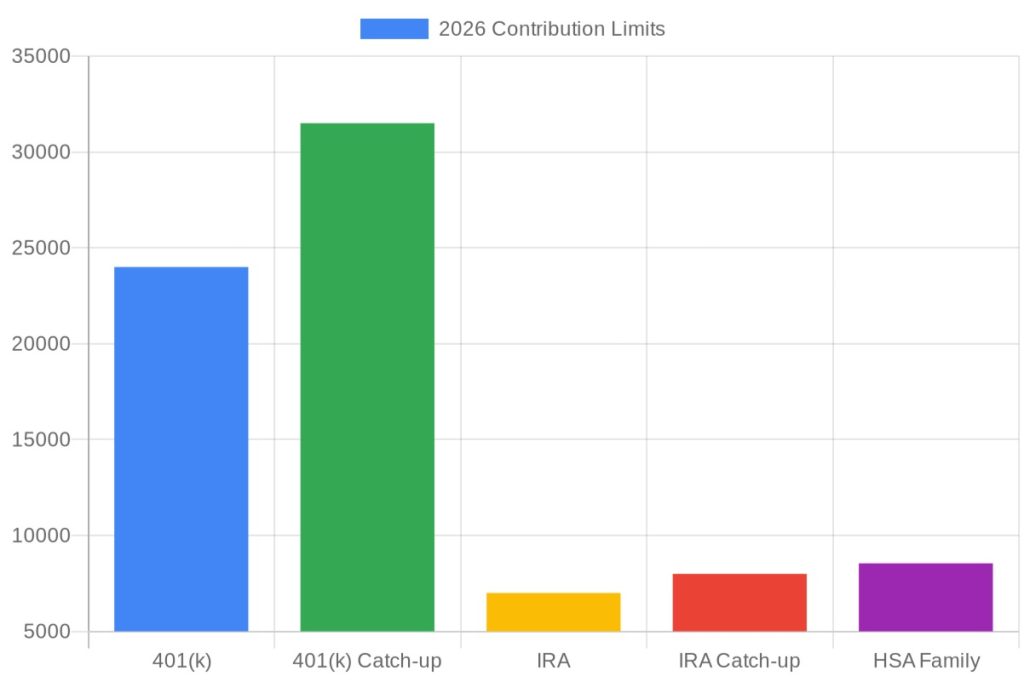
One of the most powerful and widely available tools for reducing your taxable income is maximizing your contributions to tax-advantaged retirement accounts. When you contribute to a traditional 401(k) or a traditional IRA, you are typically doing so with pre-tax dollars. This means that every dollar you contribute is a dollar that is subtracted directly from your gross income for the year, which in turn reduces your Adjusted Gross Income (AGI). A lower AGI is the cornerstone of effective tax planning, as it not only lowers the amount of income subject to tax but can also be the key to unlocking other valuable deductions and credits that have strict income limitations. For 2026, the IRS allows you to contribute up to $24,000 to your 401(k), with an additional $7,500 catch-up contribution if you are age 50 or older, bringing the total to $31,500. For a traditional IRA, the 2026 limit is $7,000, plus a $1,000 catch-up contribution for those age 50 and over [2].
Your first priority should always be to contribute enough to your employer-sponsored 401(k) to receive the full company match. Many employers offer to match a certain percentage of your contributions, such as 50% or 100% up to a certain limit (e.g., 6% of your salary). This is a guaranteed, immediate return on your investment—it is essentially free money that is part of your total compensation package. Failing to capture this full match is one of the most common and costly financial mistakes an employee can make. Once you have secured the full match, your goal should be to increase your contributions until you reach the annual maximum allowed by the IRS, if your budget permits. The tax savings from this strategy are substantial. For an individual in the 32% federal tax bracket, contributing the maximum $24,000 to a 401(k) translates into an immediate federal tax reduction of $7,680 for that year. All the while, these funds are invested and grow in a tax-deferred environment, meaning you pay no taxes on the dividends, interest, or capital gains until you begin making withdrawals in retirement. This tax-deferred compounding is a powerful engine for wealth creation.
If you do not have access to an employer-sponsored plan, or if you have already maxed out your 401(k) and wish to save even more, a traditional IRA is your next best option. The tax benefits are similar, although the contribution limits are lower. It is important to note that the deductibility of your traditional IRA contributions can be limited if you or your spouse are covered by a retirement plan at work and your modified adjusted gross income (MAGI) exceeds certain thresholds. However, even if your contribution is not deductible, you can still make a “nondeductible” contribution to a traditional IRA. While you won’t get an upfront tax break, the money will still grow tax-deferred, which is a significant long-term advantage over a standard taxable brokerage account. For self-employed individuals, the options are even more robust. A SEP IRA (Simplified Employee Pension) or a Solo 401(k) allows you to make substantial tax-deductible contributions, often far exceeding the limits of a standard 401(k), as you can contribute as both the “employee” and the “employer.” These plans are a cornerstone of tax planning for entrepreneurs and small business owners.
How Do Investment Strategies Lower Your Taxes?
Beyond retirement accounts, the way you manage your taxable investment portfolio can have a profound impact on your annual tax bill. Two of the most effective strategies for minimizing the tax drag on your investments are tax-loss harvesting and strategic asset location. These techniques, when applied consistently, can add significant value to your portfolio over the long term.
Tax-loss harvesting is the practice of intentionally selling investments that have decreased in value to realize a capital loss. These losses are then used to offset capital gains you may have realized from selling other, more profitable investments. By offsetting gains with losses, you can dramatically reduce or even eliminate the taxes you owe on your investment profits. The rules are straightforward: short-term losses must first be used to offset short-term gains, and long-term losses must first offset long-term gains. If you have any net losses remaining, you can use them to offset the other type of gain. If you still have a net capital loss after offsetting all of your capital gains for the year, you can use up to $3,000 of that loss to reduce your ordinary income, which is typically taxed at a much higher rate. Any remaining capital losses beyond the $3,000 limit are not lost; they can be carried forward indefinitely to offset gains or income in future years. This makes tax-loss harvesting a powerful tool for managing your tax liability year after year.
The key to successful tax-loss harvesting is to perform the transaction without fundamentally altering your long-term investment strategy or asset allocation. You don’t want to sell a core holding just to book a loss and then sit on the sidelines in cash, potentially missing a market rebound. This is where the concept of a “replacement” investment comes in. After selling a security at a loss, you can immediately reinvest the proceeds into a similar, but not “substantially identical,” security. For instance, you could sell an ETF that tracks the S&P 500 and buy another ETF that also tracks large-cap U.S. stocks but follows a different index. This allows you to maintain your exposure to that asset class while still legally claiming the tax loss. It is critical, however, to be mindful of the IRS “wash sale” rule. This rule disallows the tax loss if you purchase a substantially identical security within 30 days before or after the sale that generated the loss. A careful and disciplined approach is required to execute this strategy correctly.
Asset location is a complementary strategy that focuses on placing your investments in the most tax-efficient accounts. The core principle is to hold your least tax-efficient assets—those that generate frequent and highly taxed income, such as high-yield corporate bonds, REITs, and actively managed mutual funds that have high turnover—inside your tax-advantaged retirement accounts (like a 401(k) or IRA). Within these accounts, the annual income and capital gains distributions are shielded from taxes, allowing them to grow and compound without creating a tax drag each year. Conversely, your most tax-efficient assets—such as broad-market index funds, tax-managed mutual funds, and individual stocks that you intend to hold for the long term—should be placed in your taxable brokerage accounts. These investments tend to generate fewer taxable events, and when they do, the gains are often qualified dividends or long-term capital gains, which are taxed at preferential rates. By thoughtfully allocating your assets across your different account types, you can significantly enhance your portfolio’s after-tax returns over the long run, a concept often referred to as maximizing your “tax alpha.”

How Can You Use Charitable Giving to Reduce Your Tax Bill?
For many people, charitable giving is a core value. Fortunately, the tax code provides significant incentives for this generosity, but unlocking these benefits requires a strategic approach, especially in light of recent tax law changes. The Tax Cuts and Jobs Act of 2017 nearly doubled the standard deduction, which means that a large percentage of taxpayers no longer find it advantageous to itemize their deductions. For 2026, the standard deduction is a substantial $31,500 for married couples filing jointly and $15,750 for single filers [1]. To get any tax benefit from your charitable gifts, your total itemized deductions—which include your state and local taxes (capped at $10,000), mortgage interest, and charitable contributions—must add up to more than your standard deduction amount. For many, this is a high bar to clear.
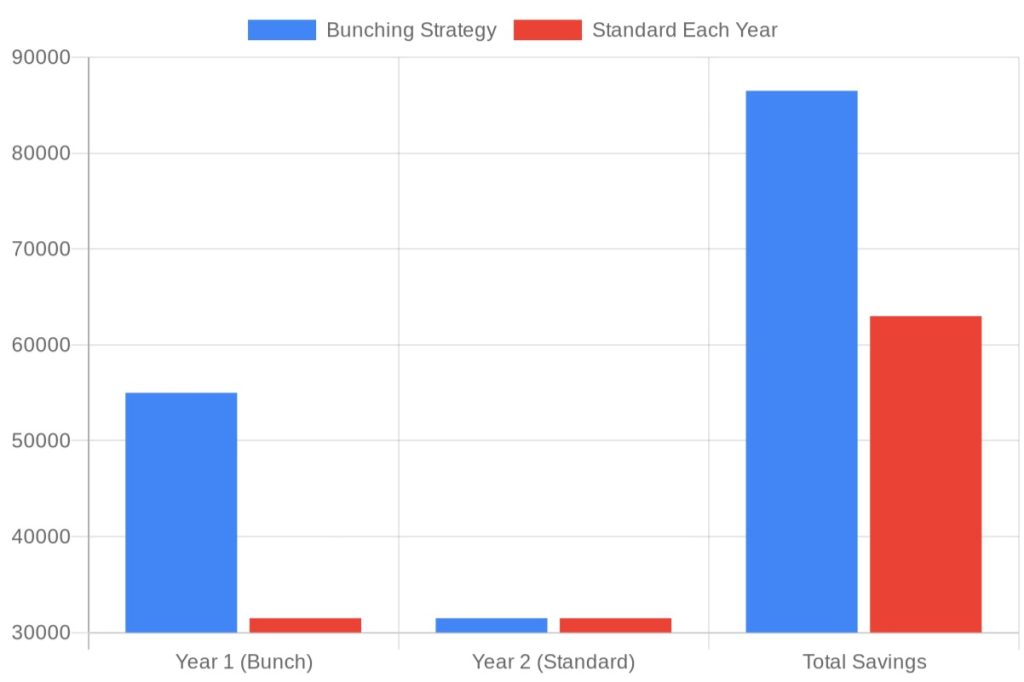
This is where the strategy of “bunching” or “bundling” charitable contributions comes into play. Instead of making regular, smaller donations each year, you concentrate several years’ worth of giving into a single tax year. For example, a married couple that typically donates $15,000 to charity annually could instead make a single $45,000 contribution in one year and then make no contributions for the following two years. Let’s assume their only other itemized deduction is the $10,000 SALT deduction. In the year of the large gift, their total itemized deductions would be $55,000 ($45,000 + $10,000). This is significantly more than their $31,500 standard deduction, allowing them to deduct the full amount and receive a substantial tax benefit. In the other two years, they would simply take the standard deduction. This strategy allows you to get a tax break for your generosity that would be completely lost if the donations were spread out evenly.
A Donor-Advised Fund (DAF) is an exceptionally effective and increasingly popular vehicle for implementing a bunching strategy. Think of a DAF as a dedicated charitable investment account. You make a large, irrevocable contribution to the DAF, and you are eligible to take the maximum tax deduction for that contribution in the year you make it. The funds in the DAF can then be invested and grow tax-free. From there, you can recommend grants from the fund to your chosen IRS-qualified public charities on your own timeline—whether that’s over the next several months or the next several years. This structure decouples the timing of your tax deduction from the timing of the actual charitable distributions, giving you a powerful combination of immediate tax savings and thoughtful, deliberate philanthropy. Furthermore, one of the most tax-efficient ways to fund a DAF is by donating long-term appreciated securities (stocks, bonds, or mutual funds) that you have held for more than a year. When you do this, you are generally able to deduct the full fair market value of the securities at the time of the donation, and, just as importantly, you completely avoid paying the capital gains tax you would have incurred if you had sold the securities yourself. This allows you to make a larger gift to charity and receive a larger tax deduction, all at a lower out-of-pocket cost.
For individuals who are age 70.5 or older and have a traditional IRA, the Qualified Charitable Distribution (QCD) is another indispensable tax-planning tool. A QCD allows you to directly transfer up to $100,000 per year from your IRA to one or more qualified charities. The amount of the QCD is not included in your AGI for the year. This is a crucial distinction. Because it’s an “above-the-line” exclusion from income rather than an itemized deduction, you get the full tax benefit regardless of whether you itemize or take the standard deduction. Furthermore, a QCD can be used to satisfy your annual Required Minimum Distribution (RMD), which is the amount you are legally required to withdraw from your traditional retirement accounts each year starting at age 73. By using a QCD to fulfill your RMD, you can meet your withdrawal obligation while simultaneously supporting your favorite causes and avoiding the income tax that would normally be due on the RMD amount. For retirees, this is often the most tax-efficient way to give to charity.
Table 2: Comparison of Charitable Giving Strategies
| Strategy | Description | Key Tax Benefit |
| Bunching Contributions | Concentrate multiple years of donations into one year to exceed the standard deduction. | Allows you to itemize and deduct charitable gifts that would otherwise be lost. |
| Donor-Advised Fund (DAF) | Contribute to a dedicated charitable fund, then recommend grants over time. | Immediate, maximized tax deduction; avoids capital gains tax on appreciated assets. |
| Qualified Charitable Distribution (QCD) | Direct transfer from a traditional IRA to charity for individuals age 70.5+. | Excludes the distribution from taxable income; satisfies Required Minimum Distribution (RMD). |
How Can Timing Your Income and Expenses Reduce Your Taxes?
Beyond what you deduct, when you recognize income and pay for expenses can be a powerful lever in your tax planning toolkit. The ability to strategically shift income and deductions between tax years can create significant savings, particularly if you anticipate a change in your income or tax bracket. The core principle is simple yet profound: whenever possible, you want to defer the recognition of income into a future year and accelerate the payment of deductible expenses into the current year. This dual maneuver reduces your taxable income for the current year, thereby lowering your immediate tax bill and freeing up cash flow.
Deferring income is a strategy that requires foresight. If you are self-employed or a consultant, one of the most direct ways to do this is by managing your invoicing schedule. By sending invoices for work completed in December late in the month, you can often ensure that the payment arrives in January of the following year, effectively pushing that income into the next tax period. For employees, the opportunities are more limited but still exist. If you are eligible for a year-end bonus, you can sometimes negotiate with your employer to have it paid out in January instead of December. It is critical to understand the IRS doctrine of “constructive receipt,” which states that you are taxed on income when it is made available to you without substantial restriction, not when you actually have the cash in hand. This means you cannot simply choose not to cash a check that you have already received. Any arrangement to defer income must be made before you have a legal right to receive the funds.
Accelerating deductions is the other half of this powerful equation. This involves paying for expenses that you would normally incur early next year before the current year ends. For example, you can make your January mortgage payment in December, allowing you to deduct the interest portion in the current tax year. You can also prepay your state and local income taxes or property taxes before December 31st. However, remember that the total deduction for all state and local taxes (SALT), including property, income, and sales taxes, is capped at $10,000 per household per year. If you are already at this limit, prepaying more will not provide any additional federal tax benefit. For business owners, this strategy is particularly potent. You can purchase necessary office supplies, pay for professional development courses, or invest in new equipment before the year is out to claim the deductions immediately.
The strategy of bunching itemized deductions, which we touched on earlier in the context of charitable giving, is a perfect real-world application of this timing principle. By concentrating as many of your discretionary deductible expenses as possible into a single “on” year, you can create a total that far exceeds your standard deduction, yielding a significant tax break. This could involve scheduling and paying for elective medical or dental procedures, prepaying property taxes up to the SALT cap, and, most significantly, making two or three years’ worth of charitable donations at once (perhaps into a Donor-Advised Fund). In the subsequent “off” years, with fewer itemized expenses to claim, you simply take the generous standard deduction. This alternating approach ensures that you are maximizing the tax benefit from your expenditures over a multi-year cycle, rather than letting smaller, spread-out deductions go to waste each year because they fail to meet the itemization threshold.
What Are Some Other Key Tax-Saving Opportunities?
Beyond the foundational strategies of retirement savings, investment management, and charitable giving, a number of other valuable, and often overlooked, opportunities exist within the tax code to reduce your taxable income. A Health Savings Account (HSA) stands out as one of the most powerful tax-advantaged accounts available, offering a unique triple tax benefit. First, your contributions are tax-deductible (or pre-tax if made through an employer), which directly lowers your AGI. Second, the funds within the HSA can be invested and grow completely tax-free. Third, withdrawals are also tax-free, provided they are used for qualified medical expenses. This combination is unmatched by any other savings vehicle. For 2026, the maximum contribution is $4,300 for an individual with self-only coverage and $8,550 for family coverage, with an additional $1,000 catch-up contribution for those age 55 and older [3]. To be eligible, you must be enrolled in a high-deductible health plan (HDHP). An HSA can be used to pay for current medical costs, but its true power is realized when it is used as a long-term investment vehicle for future healthcare expenses in retirement.
If you have children or are pursuing education yourself, the tax code offers several valuable credits. The Child Tax Credit provides a significant credit for each qualifying child under the age of 17. The credit amount and the income phase-outs can change, so it is crucial to check the current year’s rules. For those with dependents of any age who require care while you work, the Child and Dependent Care Credit can help offset a portion of those expenses, such as daycare or a babysitter. When it comes to higher education, the American Opportunity Tax Credit (AOTC) is available for the first four years of post-secondary education and can provide a credit of up to $2,500 per eligible student. For graduate studies or courses taken to acquire job skills, the Lifetime Learning Credit (LLC) offers a nonrefundable credit of up to $2,000. These educational credits can provide a significant boost to families paying for college.
Homeownership also comes with a suite of potential tax deductions. The mortgage interest deduction is one of the most well-known, allowing you to deduct the interest paid on up to $750,000 of mortgage debt used to buy, build, or improve your primary residence or a second home. You can also deduct the property taxes you pay, although this deduction, along with your state and local income or sales taxes, is subject to the combined $10,000 SALT deduction cap. If you use a portion of your home regularly and exclusively for your business, you may be eligible to claim the home office deduction. This allows you to deduct a percentage of your home’s expenses—such as mortgage interest, insurance, utilities, and repairs—based on the square footage of your office space. This is a valuable deduction for the growing number of self-employed individuals and remote workers.

How Do You Create a Year-Round Tax Plan?
Truly effective income tax planning is not a frantic, once-a-year activity that takes place in the weeks leading up to the April tax deadline. It is a deliberate, year-round discipline that is woven into the fabric of your financial life. Shifting your mindset from reactive tax preparation to proactive tax planning is the most important step you can take. This means that every major financial decision you make—from changing jobs and selling investments to buying a home and donating to charity—should be viewed through a tax lens. The goal is to create a dynamic, forward-looking strategy that anticipates your tax liability and takes steps to minimize it long before your tax return is due.
The first step in this process is to establish a robust system for organization. In today’s digital age, this is easier than ever. Use a combination of dedicated folders on your computer, cloud storage, and financial aggregation apps to keep meticulous records of your income, expenses, and all potentially tax-relevant documents. This includes pay stubs, W-2s, 1099s from various sources, brokerage statements, mortgage interest statements (Form 1098), property tax bills, records of charitable contributions, and receipts for any potential business or medical expenses. A well-organized system not only makes tax preparation infinitely smoother but also ensures that no valuable deduction or credit is overlooked simply because a document was misplaced.
Second, you must make a habit of conducting regular tax check-ins throughout the year. A quarterly review is a good starting point, with a more intensive review at the mid-year point and again in the fourth quarter. During these check-ins, you should project your total income for the year, review your deductions and credits, and estimate your potential tax liability. This will allow you to identify any significant deviations from your plan and make timely adjustments. For example, if you receive a large, unexpected bonus, you may need to increase your 401(k) contributions or make an estimated tax payment to avoid an underpayment penalty. Conversely, if you experience a job loss, you may want to consider a Roth conversion while you are in a temporarily lower tax bracket. These check-ins are your opportunity to be the pilot of your financial ship, making course corrections as needed, rather than being a passenger simply waiting to see where you end up.
Finally, and perhaps most importantly, do not hesitate to build a team of qualified professionals. While this guide provides a comprehensive overview of key strategies, the tax code is incredibly complex and constantly changing. A qualified Certified Public Accountant (CPA) or a Certified Financial Planner (CFP) with expertise in tax planning can provide personalized advice tailored to your unique circumstances. They can help you navigate the nuances of the law, ensure you are in full compliance, and often identify sophisticated tax-saving opportunities that you would not find on your own. The fees for professional advice are often a wise investment, as the tax savings they can generate can far outweigh the cost. A good advisor acts as your strategic partner, helping you not only to save money on your taxes but also to align your financial decisions with your most important life goals.
Deeper Dive into Investment Strategies
Let’s explore the nuances of tax-loss harvesting with a more concrete example. Imagine in a volatile year, your portfolio, which includes a diverse set of ETFs, has experienced some fluctuations. You hold 100 shares of an ETF tracking the technology sector (let’s call it TechETF), which you purchased for $200 per share ($20,000 total). It is now trading at $150 per share, resulting in an unrealized loss of $5,000. In the same year, you sold a different investment, a growth stock, and realized a long-term capital gain of $8,000. If you do nothing, you will owe capital gains tax on that $8,000 gain. However, by selling your 100 shares of TechETF, you can “harvest” that $5,000 loss. This loss can be used to directly offset your gain, reducing your taxable capital gain to just $3,000. If your long-term capital gains rate is 15%, this single transaction saves you $750 in taxes ($5,000 x 0.15). To maintain your exposure to the tech sector, you could immediately reinvest the $15,000 proceeds from the sale into a different but similar technology ETF, perhaps one with a slightly different index or expense ratio. This ensures your investment strategy remains intact while you reap the tax benefits.
Advanced Timing and Income Structuring
The concept of timing extends beyond simple deferral and acceleration. For high-income individuals, particularly those with variable or business income, more advanced structuring can yield even greater benefits. Consider the use of a Solo 401(k) for a self-employed individual. This plan allows you to make contributions as both the “employee” and the “employer.” As the employee, you can defer up to 100% of your compensation up to the $24,000 limit in 2026. As the employer, you can contribute an additional 25% of your compensation. This dual contribution structure allows for massive tax-deductible savings, significantly reducing your current-year AGI. Furthermore, many Solo 401(k) plans allow for participant loans and can be established with a Roth component, offering incredible flexibility. By timing a large employer contribution at the end of the year, a business owner can dramatically reduce their taxable income in a high-earning year. This is a powerful example of how structuring your business and savings vehicles can be a cornerstone of advanced tax planning, not just retirement, planning.
Conclusion
Mastering the art of income tax planning is one of the most empowering financial skills you can develop. It transforms taxes from a source of anxiety and frustration into an opportunity for strategic savings and wealth creation. By embracing the principles outlined in this guide, you can move from a reactive to a proactive stance, taking control of your financial destiny. Remember to prioritize valuable tax credits, maximize your contributions to tax-advantaged retirement accounts, and manage your investments with tax efficiency in mind. Use timing strategies to your advantage by deferring income and accelerating deductions, and do not overlook the powerful benefits of strategic charitable giving. By integrating these concepts into a year-round planning process and building a team of trusted advisors, you can ensure that you are not paying a penny more in tax than you are legally required to. The savings you unlock can then be redirected toward what matters most to you—whether that’s achieving financial independence, supporting your family, or making a meaningful impact on the world. The journey to tax mastery begins now.
References
[1] Tax Foundation. (2025). 2026 Tax Brackets. https://taxfoundation.org/data/all/federal/2026-tax-brackets/
[2] NerdWallet. (2026). 7 Tax Planning Strategies to Know in 2026. https://www.nerdwallet.com/taxes/learn/tax-planning
[3] IRS. (2025). HSA Contribution Limits for 2026. https://www.irs.gov/
[4] Reddit. (2023). What’s the best tax advice you ever got (that more people should know)? https://www.reddit.com/r/tax/comments/1ijezwa/whats_the_best_tax_advice_you_ever_got_that_more/
[5] Fidelity. (2026). Key tax moves for 2026. https://www.fidelity.com/learning-center/personal-finance/tax-moves

Dean Tellone is the President & CEO of Tellone Financial Services, an Anaheim-based financial planning and private lending firm he founded in 1975. An Enrolled Agent with 40+ years in mortgages, estate and retirement planning, accounting, and taxes, he oversees $200M+ in mortgage funds and continues to serve homeowners across Southern California.