You access the top free tax planning calculators for 2026 by using trusted platforms that estimate refunds, withholding levels, deductions, and the impact of tax-law updates.
This guide gives you clear direction on which free tools offer the most accurate projections, how to use them effectively, and how to build a year-round tax planning routine that improves your financial decisions. Expect expert-level clarity backed by real-time data and user-tested tools.
What free tax calculator should you use to estimate your 2026 refund?
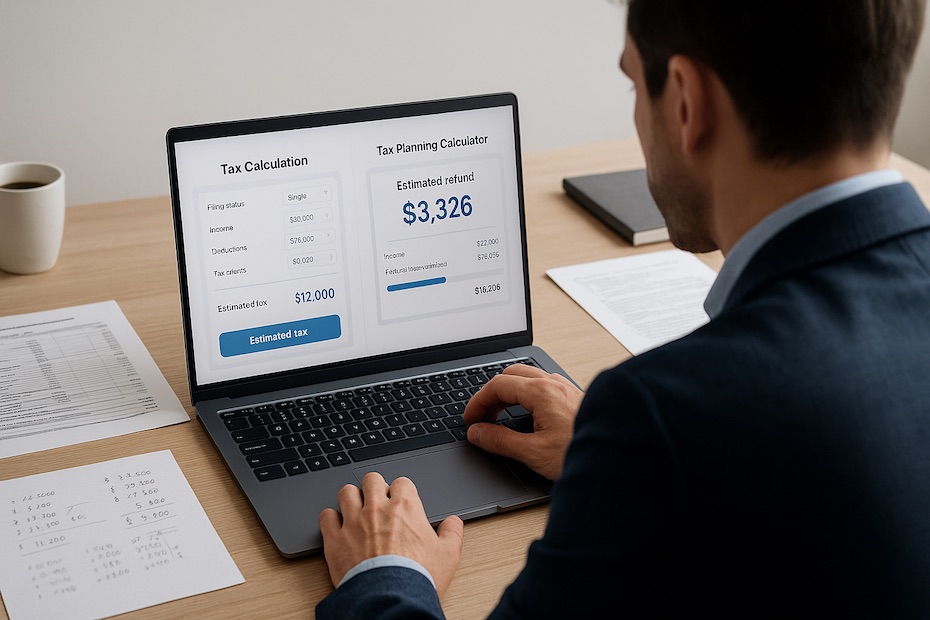
The TaxSlayer Refund Calculator is one of the most reliable tools for estimating your 2026 federal tax refund. It uses updated brackets, credits, and deductions aligned with current rules.
When you input your wages, adjustments, credits, and withholding, the tool generates a near-realistic estimate of your refund or tax bill. That number becomes your planning baseline for the year. You see whether you’re on course for over-withholding, under-withholding, or accurate withholding.
If you’re projecting a refund, you can allocate it toward savings or debt reduction. If you’re projecting a tax bill, you can adjust your strategy early in the year instead of waiting for filing season.
How do you check whether your employer is withholding enough for 2026?
The IRS Tax Withholding Estimator is the best free tool for reviewing whether your W-4 matches your income profile.
You’ll need your pay stubs, investment income numbers, and information from your last return. The calculator processes all sources of income and outputs a recommended withholding adjustment. It also shows how those changes affect your expected refund or balance due.
This tool is essential if you recently started a second job, changed pay structures, shifted filing status, or noticed a difference in year-to-date withholding. It shows you exactly where you stand and how to correct course before the tax year ends.
What free tool helps you model the effect of 2026 tax-law changes?
The Tax Foundation’s 2026 tax modeling calculator helps you compare how your income and deductions interact with updated tax-law provisions.
It allows you to input filing status, standard deduction vs. itemizing, and new bracket thresholds. When you adjust income levels or deduction scenarios, the model instantly displays your projected tax liability.
This is valuable when your income fluctuates, when you expect large capital gains, or when you want to time certain expenses. You see how decisions made today translate into tax differences next year.
What advantages do free tax planning tools offer for your financial planning?
Free calculators give you clarity without requiring software or paid services. You get actionable estimates that help you anticipate tax results before they happen.
With refund estimators, you can verify whether your tax posture supports your savings goals. With withholding tools, you manage your cash flow deliberately instead of relying on guesswork. With modeling tools, you prepare for upcoming rule changes that may affect your tax bill.
This information supports better decision-making across budgeting, investing, and debt planning. You move through the year with data that aligns your actions with outcomes you want.
How do you build a year-round workflow using these free tools?
Start with a beginning-of-year plan: use the IRS withholding estimator in January or February after any changes in income or employment.
Mid-year, use a refund estimator to identify whether you’re trending toward a refund or a bill. If the results show a potential tax bill, you have time to adjust by revising your W-4 or accelerating deductible expenses.
At the end of the year, use a tax-law impact calculator to model year-end strategies such as timing income, making charitable contributions, or adjusting retirement contributions. By doing this, you move through the tax year with control and precision.
What limits do free tax calculators have?
Free tools cannot capture every tax nuance—especially if you have multi-state income, complex investment portfolios, or rental real estate across different jurisdictions.
For example, the IRS estimator may not fully incorporate complex itemized deduction scenarios or unique credit structures. Refund calculators often rely on simplified projections that don’t account for all variables.
You use these tools as guides, not final answers. When your tax situation becomes more involved, the calculators help you frame questions for a tax professional, saving time and improving the accuracy of your planning.
How do you select the best tool for your tax planning style?
Match the tool to the type of decision you need to make.
If your concern is “Will I owe money or get a refund?” you use a dedicated refund estimator developed with updated bracket data.
If your concern is withholding or paycheck structure, you rely on the IRS’ official tool.
If your concern is anticipating policy changes or evaluating scenarios, you use a tax-law modeling tool.
This tailored selection prevents confusion and ensures you use the right resource for your financial planning needs.
What is the best way to combine multiple free tools?
Establish a sequence that supports strategic execution: check withholding first, calculate refund second, and model law changes last.
If your withholding is too low, adjust your W-4. Then run your refund estimate to confirm the impact. Finally, use law-change tools to evaluate whether you need further adjustments before year-end.
This sequence builds discipline and structure, ensuring that your earnings, expenses, and timing decisions support the tax outcomes you want.
Top Free Tax Planning Tools for 2026
- IRS Withholding Estimator
- 2026 Refund Estimator
- Tax-law modeling calculators
- Free deduction/credit lookup tools
- Income and withholding scenario planners
Maximize Your Tax Strategy in 2026
Free calculators help you understand your tax situation long before you file. When you combine refund estimators, withholding tools, and scenario-based models, you gain complete visibility into your financial position. You plan spending, saving, and investing decisions with accuracy and eliminate surprises at filing time. This is how you build a stronger financial year—by measuring, testing, and optimizing your tax posture with the right tools.
To deepen your planning even further, visit my soundcloud and explore additional resources built for year-round tax efficiency.

Dean Tellone is the President & CEO of Tellone Financial Services, an Anaheim-based financial planning and private lending firm he founded in 1975. An Enrolled Agent with 40+ years in mortgages, estate and retirement planning, accounting, and taxes, he oversees $200M+ in mortgage funds and continues to serve homeowners across Southern California.