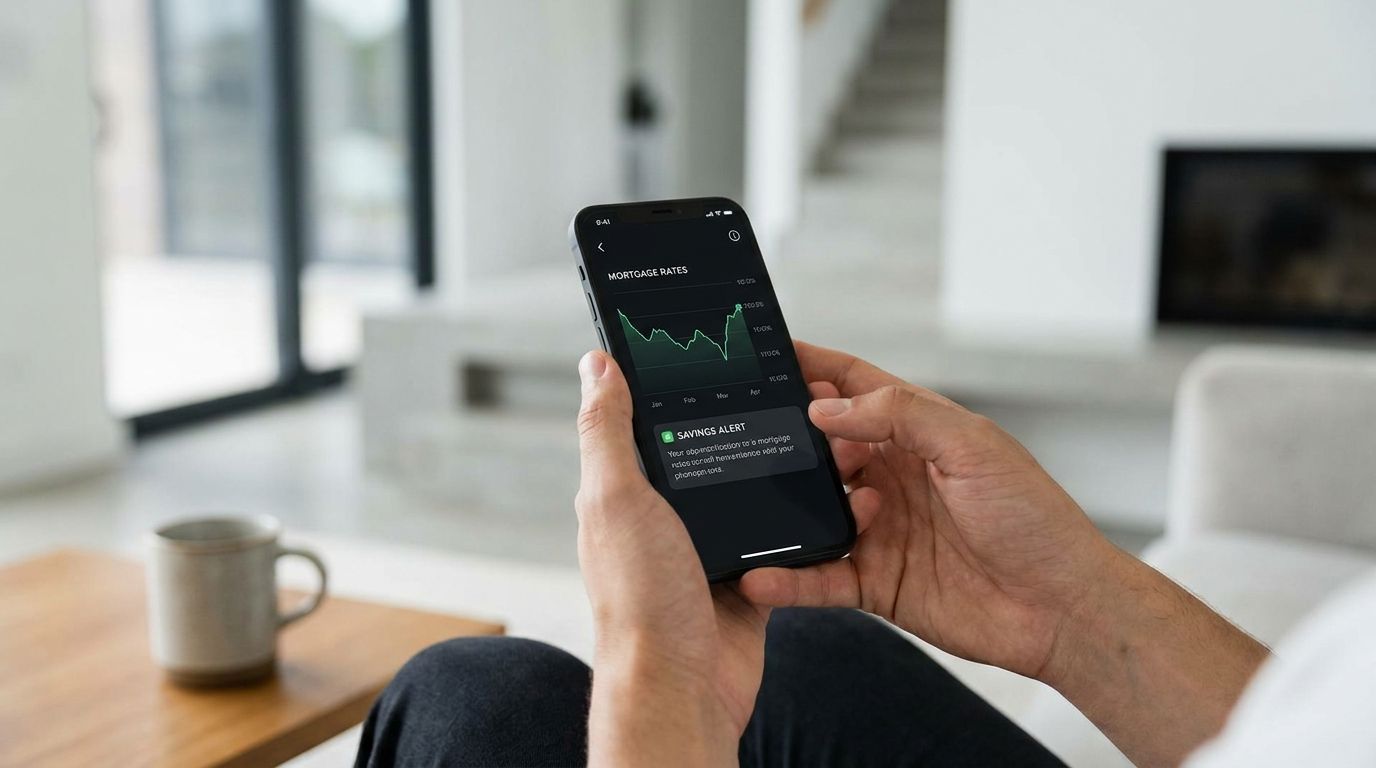
A mortgage rate alert app helps you stop overpaying by notifying you when mortgage rates move or hit your target, so you can compare lenders and request updated Loan Estimates before you lock. It’s a monitoring tool for timing decisions, not a guaranteed mortgage offer.
This article shows you how to use rate alerts to watch fast-moving mortgage rates, compare real loan offers, and decide when to ask about locking or refinancing. You’ll also see which app features matter, where rate alerts fall short, and how to avoid confusing an advertised rate with the loan terms you’ll actually receive.
Why Mortgage Rate Alerts Matter Right Now
Mortgage rates can change daily and sometimes within the same day, so a quote you saw yesterday may not match what a lender can offer today. That’s why a mortgage rate alert app can be useful: it watches rate movement for you and pushes you to act when the market moves near your target. You don’t need to refresh lender pages all day or guess whether the rate you’re seeing is stale. You need a signal that tells you when it’s time to compare, negotiate, or ask about a lock.
Recent national data shows why small rate moves deserve attention. Freddie Mac’s recent weekly survey showed a 30-year fixed-rate mortgage average of 6.53% and a 15-year fixed-rate mortgage average of 5.87%. Those are national averages, not personalized offers, but they give you a baseline for understanding the market. Your actual quote can differ based on your credit profile, down payment, loan amount, loan type, points, lender pricing, and lock status.
The payment difference can be meaningful on a typical home purchase. Using the National Association of REALTORS® reported median existing-home price of $417,700 and assuming 20% down, the estimated loan amount is $334,160. On a 30-year fixed mortgage, a half-point rate swing can change the monthly principal and interest by roughly $100 or more. That doesn’t include taxes, insurance, mortgage insurance, points, or closing costs, but it shows why rate monitoring can affect your monthly budget.
|
Mortgage Rate |
Approx. Monthly Principal And Interest |
Difference Vs. 6.53%
|
|
6.03% |
$2,010 |
Saves About $109/Month |
|
6.28% |
$2,064 |
Saves About $55/Month |
|
6.53% |
$2,119 |
Baseline |
|
7.03% |
$2,230 |
Costs About $111/Month More |
What Is A Mortgage Rate Alert App?
A mortgage rate alert app tracks mortgage rate changes and sends you a notification when rates move or reach a number you choose. Some apps focus on national mortgage rate averages, some show daily market commentary, some connect you with lender quotes, and some are built more for mortgage professionals than homebuyers. The right app depends on whether you’re buying, refinancing, comparing lenders, or monitoring rates before you start the application process.
A good rate alert tool turns rate watching into a set of decisions. If rates drop near your target, you can request updated quotes from lenders. If rates rise, you can ask whether locking protects your budget. If you already own a home, you can run refinance numbers instead of reacting to every small daily movement.
Apps in this category vary. Mortgage News Daily promotes real-time mortgage rates, rate-change notifications, calculators, local lender rates, and market news. Rate’s app listing says users can set rate alert goals and receive push notifications when goals are met. RateWatch.us promotes target-rate alerts and a refinance calculator, and RateAlert.com appears aimed more at mortgage professionals with market data, alerts, and loan-officer tools.
How A Rate Alert App Helps You Stop Overpaying
A rate alert app helps you stop overpaying by giving you a reason to act before a better opportunity passes. It can’t force a lender to give you a lower rate, and it can’t replace a formal quote. It can help you ask for updated pricing at the right moment, compare lenders within a focused shopping window, and avoid choosing the first offer without knowing whether better terms exist.
That matters because many borrowers don’t shop. Consumer Financial Protection Bureau mortgage-shopping research found that almost half of consumers who take out a purchase mortgage fail to shop before applying, and fewer than one in four submit applications to more than one lender or broker. The same research found that consumers who felt confident about available mortgage rates were almost twice as likely to shop as consumers who were unfamiliar with available rates. A mortgage rate tracker can help you become the kind of borrower who knows when a quote deserves a closer look.
The best use is simple: set a target rate, wait for a mortgage rate notification, then compare real Loan Estimates. If one lender improves pricing after a rate drop, you can ask another lender to match or beat the offer. If rates start moving up, you can ask whether it makes sense to lock. Alerts don’t make the decision for you, but they do put you in the conversation sooner.
The Features Your Mortgage Rate Alert App Should Have
The mortgage rate alert app you need should do more than show a generic number. It should let you set a custom target, track common loan types, explain market movement in plain language, and help you decide when to request a real lender quote. If you’re refinancing, it should also help you estimate whether a lower rate is enough to justify closing costs. A flashy interface matters less than clean data, useful notifications, and transparency about what happens after you tap the alert.
Look for features that support your actual decision, not just rate watching. You want a tool that helps you connect the alert to a lender conversation, a Loan Estimate review, or a refinance calculation. If an app is connected to one lender, treat it as that lender’s channel rather than a neutral comparison tool. If an app is built for mortgage professionals, it may offer market data that’s useful but less suited to a consumer trying to compare offers.
- Custom Target-Rate Alerts: Set the rate that would make you request new quotes, consider locking, or review a refinance.
- 30-Year And 15-Year Tracking: Watch the loan terms most borrowers compare when choosing fixed-rate financing.
- Refinance Calculator: Estimate payment savings, closing costs, and break-even timing before contacting lenders.
- Local Lender Visibility: See whether the app offers lender-specific information or only broad national averages.
- Rate Lock Reminders: Track expiration dates so you don’t miss a lock deadline or pay for an avoidable extension.
- Plain-Language Market Updates: Understand rate movement without needing to follow bond markets all day.
- Clear Data Source: Know whether rates come from applications, lender quotes, surveys, market feeds, or app partners.
- Privacy Clarity: Check whether your information may be used for lender referrals or sales contact.
Rate Alerts Vs. Real Mortgage Offers: Know The Difference
A mortgage rate alert is not the same as a mortgage offer. A rate alert may show a national average, daily market movement, or a target rate based on the app’s data source. A real mortgage offer comes from a lender after reviewing your borrower profile and loan details. Treat alerts as a prompt to gather quotes, not proof that you qualify for the number on your screen.
Your mortgage rate is shaped by details an app may not fully know. Lenders price loans based on credit score, down payment, property type, location, loan amount, loan term, debt-to-income ratio, loan-to-value ratio, discount points, lender credits, and whether the rate is locked. Two borrowers can see the same app alert and receive different lender quotes. That doesn’t mean the app is wrong; it means mortgage pricing is personal.
You also need to compare the interest rate with the annual percentage rate, fees, points, lender credits, and total cash due at closing. A lower interest rate can come with higher upfront costs. A slightly higher rate can sometimes pair with a lender credit that reduces cash needed to close. The Loan Estimate is where those tradeoffs become visible, which is why it matters more than a standalone rate alert.
How To Use A Rate Alert Before You Lock
A rate lock means your interest rate should not change between the offer and closing, as long as the loan closes within the lock period and your application details don’t change. The Consumer Financial Protection Bureau says locks are commonly available for 30, 45, or 60 days, with longer periods sometimes available. A lock can protect you from rate increases. It can also limit your ability to benefit if rates fall after you lock.
Use your rate alert before locking by turning it into a checklist. When your target alert hits, request updated quotes from three or more lenders. Compare official Loan Estimates, not screenshots, texts, or verbal promises. If the rate looks attractive and your closing timeline is firm, ask each lender to explain the lock period, expiration date, extension cost, and whether a float-down option is available.
You should also ask what happens if rates drop after you lock. Some lenders may offer a float-down option, and some may not. Some lock extensions can cost money if your closing is delayed. Your Loan Estimate should show whether your rate is locked and for how long, but it may not show every cost tied to extending the lock or choosing a longer lock period, so ask before you commit.
How To Use A Rate Alert Before You Refinance
A refinance rate alert works best when you already know your trigger number. That trigger should come from your current loan balance, existing rate, target monthly payment, closing cost estimate, and how long you plan to keep the new loan. A lower rate alone doesn’t prove a refinance saves money. The full decision depends on payment savings, upfront costs, break-even timing, loan term, and total interest.
When a refinance rate alert hits, run the numbers before applying everywhere. Compare the new estimated monthly principal and interest against your current payment. Add closing costs, lender fees, points, prepaid items, and any escrow changes. Then divide the upfront cost by the estimated monthly savings to estimate the break-even period.
Pay attention to loan term resets. If you’re several years into a 30-year mortgage and refinance into a new 30-year loan, your monthly payment may fall, but your repayment clock starts over. That can increase total interest paid unless the rate reduction, shorter term, extra principal payments, or your ownership timeline supports the move. A refinance rate alert should start the analysis, not end it.
Common Mistakes To Avoid With Mortgage Rate Apps
The most common mistake is treating an advertised or tracked rate as guaranteed. Rate alerts are useful, but they don’t include every pricing adjustment tied to your file. If you act on an alert, your next step is to request quotes that reflect your property, loan type, down payment, credit profile, and lock timing. A screenshot from an app can help start the conversation, but it won’t replace the lender’s Loan Estimate.
Another mistake is ignoring points and fees. A lender can advertise a lower rate that requires you to pay discount points at closing. Another lender can offer a higher rate with fewer upfront costs or a lender credit. If you compare only the interest rate, you can miss the true cost of the loan.
- Waiting Too Long After An Alert: Rates may move again before you ask for updated pricing.
- Comparing Quotes From Different Days: Rate movement can make one lender look better simply because the quote was issued later.
- Skipping Loan Estimates: Informal quotes don’t show the full cost picture.
- Ignoring Lock Expiration: A delayed closing can create extension costs.
- Assuming The App Is Neutral: Some tools are lender-owned, lead-generating, or designed for professionals.
- Forgetting Credit Shopping Rules: Multiple mortgage credit checks within a 45-day window are recorded as a single inquiry under Consumer Financial Protection Bureau guidance.
Best Use Case: Who Needs A Mortgage Rate Alert App Most?
A mortgage rate alert app is most useful when you’re close enough to act. If you’re actively house hunting, under contract, preparing to refinance, or waiting for a specific rate target, alerts can help you move at the right time. If you’re only browsing homes casually, an app can still teach you how rates move, but the action value is lower. The closer you are to choosing a lender or locking a rate, the more useful the alert becomes.
Homebuyers under contract may benefit the most because timing matters. You have a closing date, a lender decision, and a rate lock decision tied together. A rate alert can help you ask for updated Loan Estimates from competing lenders within the same shopping window. It can also remind you to ask about lock terms before your timeline gets tight.
Homeowners waiting to refinance are another strong fit. You may already know your current mortgage rate and monthly payment, so you can set a more specific target. If your alert hits, you can run a payment and break-even calculation before contacting lenders. That keeps you from reacting to every small move and helps you focus on rate drops that could change your finances.
How To Compare Mortgage Rate Alert Apps
Compare mortgage rate alert apps by asking what decision the app helps you make. A daily mortgage rates app can be useful for market awareness, but it may not help you compare lenders. A lender-owned app can make it easy to apply, but it may steer you toward that lender. A professional mortgage platform may have deeper market tools, but it may feel too technical for a borrower who only needs a clean rate drop alert.
Use a simple selection test. Can you set a target rate? Can you track the loan term you care about? Does the app explain whether rates are national averages, local lender rates, or partner offers? Does it offer calculators that help with refinance or payment planning? Does it make privacy and lender contact clear before you share personal information?
You don’t need the app with the most features. You need the app that supports the next action: compare lenders, ask for an updated Loan Estimate, evaluate a rate lock, or check refinance savings. If an app sends too many alerts without helping you decide, it can create noise. If it sends a few well-timed alerts tied to your target rate, it can help you stay ready without staring at rates all day.
What To Do When Your Mortgage Rate Alert Goes Off
When your mortgage rate notification appears, don’t lock, apply, or refinance on impulse. Confirm what type of rate the app is showing, then contact lenders for updated quotes based on your exact loan details. Ask lenders to provide Loan Estimates close together in time so the comparison is fair. If you already have a preferred lender, ask them to reprice the loan and explain any difference from the alert.
Then compare the full offer. Review the interest rate, annual percentage rate, monthly principal and interest, points, lender credits, closing costs, cash to close, and lock status. A lower monthly payment can still be a weaker offer if the upfront cost is too high for your plans. A higher rate can still make sense if the lender credit lowers your cash need and you don’t expect to keep the loan long.
If you’re ready to lock, ask direct questions before you say yes. Ask how long the lock lasts, whether the lock costs money, what happens if closing is delayed, how much an extension costs, and whether any float-down option applies. If you’re refinancing, ask for enough detail to calculate break-even timing. The alert tells you rates moved; the Loan Estimate tells you whether the deal works.
What Is A Mortgage Rate Alert App?
A mortgage rate alert app tracks rate changes and tells you when rates move or hit your target, so you can compare lenders, request Loan Estimates, discuss a rate lock, or check refinance savings.
Use Alerts To Act Before Rates Move Past You
A mortgage rate alert app can help you stop overpaying, but only when you use it as a trigger for action. Set a target rate, compare at least three lenders, review official Loan Estimates, and ask clear lock questions before making a decision. Don’t confuse a national average, daily tracker, or app notification with a lender’s real offer for your file. The smartest move is simple: let the app watch the market, then let the Loan Estimate prove which mortgage costs less.
References
- Freddie Mac Primary Mortgage Market Survey
- Consumer Financial Protection Bureau: Explore Interest Rates
- Consumer Financial Protection Bureau: Compare Loan Estimates
- Consumer Financial Protection Bureau: Mortgage Rate Lock
- Consumer Financial Protection Bureau: Mortgage Credit Checks
- Consumer Financial Protection Bureau: Mortgage Shopping Research
- National Association of REALTORS® Existing-Home Sales Report
- United States Census Bureau And Department Of Housing And Urban Development: New Residential Sales
- Mortgage News Daily Mobile App
- Mortgage News Daily
- Rate App Listing
- RateWatch.us / Rate-Alert.com
- RateAlert.com.

Dean Tellone is the President & CEO of Tellone Financial Services, an Anaheim-based financial planning and private lending firm he founded in 1975. An Enrolled Agent with 40+ years in mortgages, estate and retirement planning, accounting, and taxes, he oversees $200M+ in mortgage funds and continues to serve homeowners across Southern California.