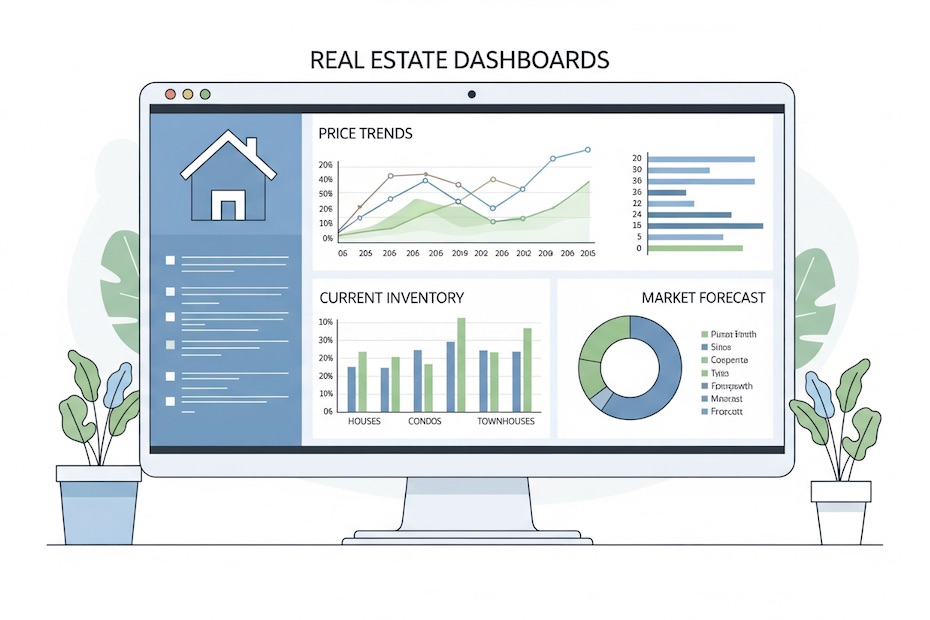
You track real estate market trends most effectively with platforms that combine accurate home price data, inventory metrics, and predictive analytics.
In this guide, you’ll discover ten leading platforms that simplify how you monitor housing prices, sales activity, new construction pipelines, and forecasting tools. You’ll also see how these platforms answer common questions real estate professionals and investors ask when making market-driven decisions.
1. Reventure App
Reventure App specializes in hyper-local tracking by ZIP code, city, or metro area. You gain access to historical pricing trends, active inventory levels, and forward-looking forecasts.
This platform stands out because it highlights “overvalued” and “undervalued” housing markets. That’s particularly useful if you want to spot areas primed for appreciation or identify overheated neighborhoods.
By comparing dozens of metros at once, you can pinpoint growth markets or hedge against softening regions. Paid tiers unlock deeper access to localized data and ZIP code granularity.
2. HouseCanary
HouseCanary offers valuation models and comparative market analysis reports powered by advanced AI. It’s trusted by lenders, appraisers, and real estate professionals alike.
With HouseCanary, you can forecast future property values, analyze comps, and identify supply-demand imbalances. This predictive capability lets you anticipate pricing pressure before it becomes obvious in listings.
Because of its enterprise-level precision, HouseCanary is valuable if you’re evaluating multiple properties or portfolios where accuracy makes a difference in financing decisions.
3. ATTOM Data
ATTOM aggregates information from property tax records, deeds, foreclosure filings, and MLS feeds into one system. Its coverage spans over 150 million properties.
The platform supplies preconfigured housing market trend reports, including delinquency rates, foreclosure activity, and neighborhood price trajectories. Investors and developers use ATTOM to gauge risks alongside growth opportunities.
When you need reliable data to plug into financial models, ATTOM ensures the metrics come from verified public and private sources, reducing blind spots in decision-making.
4. Altos Research
Altos delivers weekly reports with near real-time listing data from thousands of ZIP codes. Unlike platforms that update quarterly or monthly, Altos captures trends almost immediately.
Its reports include median list prices, inventory counts, price reductions, and days on market. Agents often use these updates to adjust pricing strategies or advise clients.
If you want to detect subtle shifts—like a sudden increase in price cuts—Altos offers visibility into the earliest signs of a market pivot.
5. Redfin Data Center
The Redfin Data Center provides free access to raw datasets covering sales prices, pending sales, and inventory statistics. You can analyze data at metro, county, or ZIP-code levels.
This tool benefits data-driven users who want to create their own dashboards, charts, or predictive models. It also includes migration data, showing where buyers are relocating from and to.
Because Redfin publishes its data openly, you can download and manipulate information for long-term comparisons or integrate it with your own tools.
6. Zillow Research
Zillow Research offers the Zillow Home Value Index (ZHVI), rental indices, and Zestimate forecasts. These help you see how specific areas are expected to perform in coming years.
With neighborhood-level granularity, you can compare appreciation patterns across cities, suburbs, or ZIP codes. Zillow also provides historical datasets, enabling longer-term market studies.
While Zestimate accuracy varies at the individual property level, the aggregated indices give you reliable direction on regional or national trends.
7. Zonda Home
Zonda focuses on new construction and homebuilding data. You see active projects, pipeline supply, and absorption rates for new housing.
This forward-looking visibility allows you to predict how future supply will influence resale markets. For instance, rising new-home starts in a market often mean resale price competition later.
Builders, developers, and investors rely on Zonda to balance current supply against future pipelines when planning acquisitions or exit strategies.
8. Comparative Market Analysis Tools
Comparative Market Analysis (CMA) platforms, often tied to MLS access, provide comps and recent sales data. These ground predictions in reality by showing what homes actually sold for.
By tracking comps regularly, you verify whether forecasted appreciation is materializing or if the market is stagnating. Agents use CMAs to set listing prices with confidence.
For small investors or homeowners, CMAs help validate whether algorithm-driven platforms are reflecting real buyer behavior in the local area.
9. Predictive Forecasting & Alerts Platforms
Some tools combine trend tracking with proactive alerts. They notify you when inventory tightens, days on market rise, or prices accelerate beyond a threshold.
Reventure and HouseCanary both offer predictive signals. These alerts allow you to act faster than competitors, whether you’re listing, buying, or adjusting financing.
By automating the early warning process, forecasting platforms reduce the chance of missing critical inflection points in the market.
10. Builder and Permit Data Trackers
Beyond resale and listing data, monitoring builder permits and planned developments offers insight into future supply. Local government permit databases, paired with platforms like Zonda, help here.
High permit activity often signals coming price pressure, while low permits with high demand suggest price support. Tracking these permits helps balance short-term signals with long-term supply dynamics.
If you’re evaluating regional investments, combining resale data with builder pipeline activity gives you a more complete picture of risks and opportunities.
Can I Compare Neighborhood-Level Trends with These Tools?
Yes, most platforms provide micro-level data. Reventure, Redfin, Zillow, and Altos allow comparisons by ZIP code or neighborhood.
This is valuable when you want to differentiate between metro averages and localized hot spots. One ZIP code might show growth while another next door declines.
Neighborhood-level analysis helps refine both pricing strategies and timing for purchases, giving you more control over outcomes.
Which Platforms Offer Forecasting for Future Housing Trends?
HouseCanary, Zillow, and Reventure all publish forward-looking forecasts, projecting home values or market direction.
Forecasting helps you avoid overpaying at the top of a cycle or selling too early in a recovery. Used with real transaction data, it improves your decision-making.
Remember that forecasts are projections, not certainties, but when multiple platforms align, it often signals a stronger likelihood of accuracy.
Benefits of Using Multiple Platforms
Using more than one platform lets you validate signals. For instance, pairing Redfin’s transaction data with Altos’ weekly listing reports provides a balance of past sales and present market action.
You also minimize risks by combining historical data, forecasts, and comps. This triangulation prevents overreliance on any one system’s algorithm.
Benefits include:
- Stronger accuracy through cross-validation
- Broader coverage of local vs. national data
- Access to both resale and new-construction signals
- Faster detection of trend reversals
Best platforms to track real estate trends
- Reventure
- HouseCanary
- ATTOM
- Altos
- Redfin
- Zillow
- Zonda
- CMA tools
- forecasting alerts
- permit trackers
In Conclusion
You enhance your real estate decisions by combining tools that capture listings, transactions, forecasts, and construction activity. Platforms like Reventure, HouseCanary, Redfin, Zillow, and Zonda give you confidence whether you’re investing, selling, or advising clients.
To see how I integrate multiple trend trackers into a streamlined system for my own projects, visit my profile here: Soundcloud.

Dean Tellone is the President & CEO of Tellone Financial Services, an Anaheim-based financial planning and private lending firm he founded in 1975. An Enrolled Agent with 40+ years in mortgages, estate and retirement planning, accounting, and taxes, he oversees $200M+ in mortgage funds and continues to serve homeowners across Southern California.